Thursday, August 21, 2008

Bill Drummond – ‘17’

Momus has it that in the age of information (i.e. now) everyone will be ‘famous for fifteen people’. Instead of Beatlemania and T-Rexstasy in the 1960s and 1970s, big bands with big budgets and big audiences, what we now have is a far wider choice of recording artists with far smaller fan bases. Bill Drummond, another pop star drawn to the art world in recent years, has the figure at 17. Or rather, in reacting to the same situation, he has come up with alternative future, in which performers and audience merge, and in which no more than 17 people will ever hear the same piece of music. It’s as though he has taken things as they are (or as they are likely to become), and shifted them around a bit, so that the same thing happens by design. Putting the svengali back at the helm of pop, or – now that it has broken up – making his proxies the coxes of a million different rowing boats. Is this beginning to sound contradictory yet? Good.

Drummond’s idea is that recorded music is finished. Everything’s been done before, it’s no longer exciting; for music to evolve it needs to leave behind recording (i.e. painstaking, multi-track recording, intended for the repeated listens of the multitude) and become spontaneous, site-specific. Being a man of action, he has set the ball rolling with The17, a choir he has dreamt up, of ever changing membership, who have forgotten everything they knew about music, except that it is vitally important to them: when they sing they have to re-imagine it from scratch. He has spent the last few years conducting (if that’s the word) performances by The17, gathering different groups of 17 people, presenting them with scores made up of instructions but no musical notation or lyrics. The scores resemble those of ’60s experimental musicians like (struggles to remember, until Bill mentions...) Cornelius Cardew, and the way they allow for chance ties in with the little I know of John Cage. Actually, they don’t look like any Cardew scores that I can find online, but isn’t this one just beautiful?

It’s interesting that Bill never address the popularity part of pop directly. The closest he gets is the disclaimer in chapter one: ‘If you are hoping this book will investigate the more high-profile moments of my progress, DO NOT read any further.’ (p. 7). Of course, his work has always been about mass appeal, and almost always obliquely: The KLF’s legendarily brattish and noisy Brit Awards performance made sense only because of the large number of records they sold in the previous year. The K Foundation’s full page broadsheet ads, even if no-one understood them, were still full page broadsheet ads. Bill’s love of the spectacle is what makes him brilliant, but in his writing he has an almost fanatical aversion to mentioning it. All his efforts in the direction of telling you what he is like have him visiting libraries and supermarket cafés, scribbling away in his notebook; or concocting stupid rules for himself relating to the CDs he is supposed to have stopped caring about; or driving, driving, driving. Only when he has convinced himself that he has convinced the reader that he is the most boring man in Britain will he lose concentration for a chapter or two and let out the most exciting, populist thing you ever heard. Like meeting Little Richard in the early ’80s:

‘Are you the boy from the record company?’

‘Yes, sir.’

‘And who am I?’

‘Little Richard.’

‘And what is Little Richard?’

I thought fast: ‘The Real King of Rock ’n’ Roll.’

‘That is correct. And what else am I?’

‘It depends.’

‘It depends? I’ll tell you what I am. I am the most beautiful man in show business.’

And he said that with a bit of a shriek and then giggled afterwards as if to let me know that he is OK and quite approachable really.

Then he says, ‘Come closer. I want to see your face properly.’ I move closer.

‘Closer still, boy.’

I move closer again.

‘Real close.’

My face is now about 18 inches from his. He stares into my eyes and then lets out the loudest non-amplified vocal sound I have ever heard in my life.

‘A WOMP-BOMP-A-LOO-BOP, A WOMP-BAM-BOOM’. (pp. 120-1)

Unlike Momus, Bill loves the spectacle. He sees it threatened, and responds with an idea which tries to turn fragmentation into a mass event by combining it with experimental music. No one else would be so stupid. He defends his right to make up what he’s doing as he goes along by saying:

As soon as an artist knows what they are doing and how to do it and why, they are dead. (p. 304)

And he’s right. How can you be an explorer if you already have a map? I think the final chapter here is the best thing he’s written, and I won’t spoil it by saying why, but 17 is an appropriate response to our times: concerned with process over product, trying to find a way back to being a fan, when stardom itself is on the wane. And yes, it’s just as good as 45.

Monday, August 18, 2008

Kristin Hersh – ‘Paradoxical Undressing’, St Cecilia’s Hall, Edinburgh, 17th August

A man who must be Billy, Kristin’s husband and manager, takes to the low stage in a twilit room with an oval roof and an oval skylight. There is a lectern and a large white screen, which will be used for back projections of paintings (by Molly Cliff-Hilts, says the programme). He does some diffusing, tells us we can clap or laugh if we like, or not if we don’t. Leaving the stage, he attracts some applause himself and puts a stop to it: ‘Don’t clap.’ Which is funny, but I wonder why he feels the need to tell us these things? She’s only going to be reading book extracts, surely? There is a book in the works, with the same title as this show, both being ‘inspired by my teenage diaries’. Something like her appearance on Powell’s Books’ ‘Bookcast’, maybe? Her funny and deliberate prose in her deep and rich voice, some scary songs (I listened to this again at lunchtime today – what is the point of being disarming with people, I thought, if you’re going to lay them out cold with ‘Delicate Cutters’ afterwards? Hanging up my coat as I arrived back, putting my tears away). But no. Nothing like that.

She is dressed in white with a black guitar. Electric, but it sounds deep, warm and half acoustic. She plays the whole way through, more languidly than you’d imagine she could – The Grotto is the closest her recorded playing comes to it. The few repeated chords conjure up a spaghetti western desert. She starts to read: ‘The handmade Jesus on Mr and Mrs Boluc’s living room wall has no face, just a gasping, caved-in head with blood dripping down its chest.’ The online text has ‘jerry-rigged Jesus’, which is even better. Her voice doesn’t take you too far from the western idea, this could be the preamble to some lawless tragedy. I close my eyes for the first few minutes, because I can’t breathe, I can’t leave… but that’s not quite it, it isn’t suffocating. There is something in Kristin’s performance, running through it, the whole thing, comparable to whatever it is that runs through her early records. It’s not something that has been consistently present in her work for a long time, though there have always been flashes. A man made of butter fat careening around on a sno cat. It isn’t the same, it’s older, less fraught. It is placid and it is hurt. It is powerful and affecting but it is not oppressive. This is a surprise: the feeling of being belted around the head by ‘Vicky’s Box’ slowed and withstood, brought under control. It is a good and a positive thing.

Songs are interspersed with the readings, ‘Fish’ first, which as an early song you might expect, also ‘Hook in her Head’, vicious, drained of its pop. Then ‘Slippershell’, a much more recent song (from this year’s series of downloads), but it fits in so well. This was another surprising thing: how cohesive Kristin’s songs are, how well songs from different records go together, given a bit of explanation. She describes various animal hallucinations (her arm as a snake, the wolves that made it into ‘Mania’), including some ‘mechanical bees’, before singing part of ‘Buzz’. There are the people living around and about whilst the Muses got under way – junkies and painters (she prefers the junkies), interchangeable house mates, and an old forgotten film star who was somehow at college with Kristin, comes to her shows with her priest and insists that she must flirt with her audience. There is a dream-like description of a car crash, in which her foot falls off and her face becomes a hamburger (‘I’d ask her to help find my foot, but who would want to help someone with a hamburger for a face?’) The biggest laugh of the evening goes to the line ‘Camel shit shoes – don’t wear them in the rain!’ It’s a funny show. Also surreal, sad, spooky. 24 hours later I’m still tingling. And feeling for the first time that I have witnessed something as uncontrollably great as those early Muses records. Totally fucking unmissable – you have until next Saturday to catch the Edinburgh run.

Saturday, August 09, 2008

Happy Birthday Beano: The Official 70th Anniversary Exhibition, Lamb Gallery, Dundee University

You hear some strange things about Beano publishers D. C. Thomson, living in Dundee. A colleague at an old job remembered seeing their office in the 1960s: clerks standing at sloped desks with inkwells, straight out of the nineteenth century. And a question to be filled in at a job interview I once had there: ‘Which church do you attend?’ Why on earth would they want to know something like that? A couple of things which make me uneasy about revisiting The Beano now, on the occasion of its 70th birthday. More generally, I can’t help being slightly suspicious of the corporate side of things: The Beano isn’t one artist or writer’s vision, or even an editor’s, it is an accumulation, a movement by trial and error towards the conclusion that naughty kids are what nice kids want to read about. Once it arrived at this very successful idea, some time in the 1950s, it stuck to it, and hadn’t shifted by the time I was reading in the 1980s. Laura Howell’s website describes her current Beano strip Johnny Bean as ‘ASBOs come to Trumpton’, which suggests that not much has changed since then, either. Another part of me – the ten year old boy, who adored the comic – is delighted to go back for another look.

Howell’s short talk at the exhibition opening fuelled my suspicions somewhat: the writing for Johnny Bean is done ‘in house’, she said. By an individual? A committee? It just sounded a bit needlessly secretive. Perhaps the company is slowly becoming less so: artists can now sign their work, at least. When I was reading, you had to identify signed work by the same artists in rival publications (Whizzer & Chips, Buster – the IPC comics) to find out who had drawn what. Beano-only artists (like David Sutherland, who drew Dennis the Menace and The Bash Street Kids) remained anonymous. Howell’s talk was really good, giving a rounded account of what it’s like to be a Beano artist: sketching a set of characters into existence for her own strip, ‘ghosting’ other artists when drawing theirs (‘if the ghosting is well done, the reader shouldn’t be able to tell the difference’), and trying to establish a happy medium between convention and her own drawing style when taking on old favourite Minnie the Minx. She showed us a Manga-influenced updating of Billy the Cat which looked great, made perfect sense.

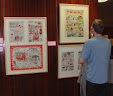
The exhibition itself is almost entirely comprised of mounted original artwork. It’s fascinating to see the way some strips were put together: drawings cut out and glued on to the main sheet of paper, then drawn on some more to make them fit the boxes*; lettering carefully following ruled lines. As you walk in you have Roger the Dodger, Dennis the Menace and The Bash Street Kids to your left: this is all I saw for some time, in fact, being slightly overawed in their presence. The Bash Street Kids strip is one of Leo Baxendale’s: two pages, one drawing on each, masses of detail as the Kids first look through the glass of an aquarium, then jump in and get a hiding from the creatures within. Dennis is riding a stagecoach pulled by a bull in his strip, and again this takes a whole page. On the gallery tour D. C. Thomson archivist Morris Heggie pointed out that Dennis’ face is drawn on top of several layers of white-out, explaining that artist David Law was something of a perfectionist. Which was unexpected, because his lines are always so shaky. A little further on, into the ’70s, we came to a large Dennis drawing from an annual cover – still shaky, but less so. David Sutherland, also present, explained that this was him ghosting David Law, and contrasted it to the far surer line he used (and still uses) to draw The Bash Street Kids, which – initially at least – found him ghosting Leo Baxendale. This quiet old gentleman has drawn the strip for almost half a century and lives just along the road from here. He didn’t want to give a talk, but agreed to accompany the group around, and answer questions.

As we moved on to the 1980s, the lines in the art became surer still – too much so, perhaps. Particularly in the Grandpa and Tom, Dick and Sally strips (both on show), which were never really up to scratch, being too clean cut. Lettering was replaced with type, stuck to the page with glue, and this reduced the hand-made feel still further. Still, it made the impact of Tom Patterson’s more chaotic style all the greater, of which there is one example on display (not Calamity James, sadly). There is much else in the exhibition to love: some fantastic World War II Lord Snooty strips, some early Dennis the Menaces, an incredible Leo Baxendale Minnie the Minx which verges on war itself (rival gang destroys most of Minnie’s gang’s hut but have to pause for lunch; before they come back, Minnie equips herself with a castle). Standing next to the latter, Heggie told us something of the tensions between Baxendale and the editorial staff: the artist wanting to produce outlandish set pieces the whole time, his editors arguing that the strips should be a bit more normal, that kids didn’t want to have their minds blown every week. He likened the appeal of comics to that of soap operas: people like to be comforted. Which I’m sure is right, but it’s the more ambitious stuff which steals the show here.

The exhibition continues until 20th September.


* Apparently this wasn’t typical: the Roger the Dodger strip shown above was drawn for the weekly comic, then re-sized for an an annual. Each individual frame was slightly enlarged.

Wednesday, July 30, 2008

Momus with Germlin, Stereo, Glasgow, 27th July

He’s laying out pom poms on the floor. Not on the stage, on the space in front of it. First he put down a silk handkerchief and smoothed it out, diamond shaped; now he’s arranging pom poms on it. Later on he will crouch in the same spot and lob some of them into the audience, his machines going crazy behind him. I wonder if he spends his days on the tour bus winding wool around cardboard hoops, replenishing his supply. Then I remember that Germlin isn’t playing the whole of Momus’ tour, only tonight, when they are to debut some of the songs they’ve been collaborating on long distance. Momus probably doesn’t have a bus either: a glove compartment would be sufficient for the microphone, lyric book and iPod that constitute his musical equipment for the show. But then he hates cars, so maybe he brought them in a knapsack, on a train with WiFi, blogging the whole time about the promptitude and cheapness of German public transport in comparison with Britain’s random pricing model, indicative of our willingness to put up with things, and their capacity for getting things done.

I don’t have the right frames of reference to describe Germlin’s music. The closest I can think is that it spazzes out as randomly as Max Tundra, with the energy of µ-Ziq’s Tango N’ Vectif. But I don’t know if that really does justice to the energy part. Germlin is all over the place during his set: jumping up on his equipment table (laptop, heavily taped up boxes with knobs on, a Stylophone), howling into a microphone, dancing around in his intense little space between the front of the stage and the handkerchief, hunched, possessed by this beat then that, battered around like a canoe in a tempest, or a moth at a My Bloody Valentine gig. The howls get heavily treated, are never identifiable as vocal sounds, and he fucks them up further with feverish scribbles on the laptop’s touchpad. Between songs he shouts unamplified as though in pain, ‘Thank you!’, ‘You can move closer if you want!’ and ‘This is the last song! Then I’m going to be doing some with Momus!’ It’s not even as if there aren’t any tunes – there are loads. Smashed around, and doubly thrilling for it. What’s not to like?

Every so often during Germlin’s set, a figure in clogs, a dress and an eyepatch hops politely from the shadows to take pictures, and it’s so strange to see him in the flesh, this electronic presence, the curious man, the modern Scheherazade, with his one man campaign to make the internet an intelligent place. He’s new to me, Momus. I don’t think I’d come across him before he wrote about Scott Walker’s The Drift a couple of years ago. Or was it when A. played ‘The Hairstyle of the Devil’ at his DJ spot in the place that had no CD decks, and he gave S. a copy of Tender Pervert when she asked him about it? That would have been around the same time. And here was this guy who took the Pet Shop Boys’ sound and was so free and erudite with it, not that they weren’t erudite, but… why hadn’t I heard of him? I was so chuffed. There was so much to discover. I got some of the records, became addicted to Click Opera. Circus Maximus and Hippopotamomus were the ones I really liked. Ocky Milk, his latest, is fab too. The Ultraconformist, the fake live album, is the one that the real live show most recalls, Momus’ delivery at its most energetic and Brechtian. Add this low down knockabout cabaret to Germlin’s perfectly formed headfucks, then chuck in some mime as Momus drapes himself around and around a pillar, and you have something of a winning formula. Can’t wait for the record.

As if this wasn’t enough, which it easily could have been, we then got eighteen songs spanning the whole of Momus’ career, one per album. Highlights were ‘His Majesty the Baby’ (really grotesque delivery on that one), ‘Hairstyle of the Devil’ (the alternative ‘It’s A Sin’, that sound at that volume… oh my!), ‘What Will Death Be Like?’ (inevitably recalling Brel’s ‘My Death’, Momus just stopped himself from breaking into Del Amitri’s ‘Nothing Ever Happens’ at the end, ‘because he’s [cousin Justin of Del Amitri] here tonight! And that is what death will be like – nothing ever happens!’), the wonderfully stately ‘Nervous Heartbeat’ (Momus saluting its entrance and exit), and, and, and… It was some show. A blast for a new convert like me, significantly stranger for long term fans – A. said it was like watching his youth slip past him, year by year. The relentlessness of Momus’ output shortcircuiting the usual experience of seeing old bands, when you recall their few productive years vividly, maybe there’s a gap and then there are some new songs, and that makes some kind of sense, there’s a connection to a fixed and manageable past. Nostalgia, in fact. This rigid progression (literally too – that iPod wasn’t stopping for anyone), the use of backing tracks from the actual records in some cases, and the fact that there wasn’t a gap, emphasised the passage of time in an unnervingly linear way. Even if you weren’t listening to him in 1986 – that was twenty two years we saw just peel away, song by song. The effect was a kind of Proustian overload: madeleine after madeleine.

Though Germlin had packed up his equipment long before the encore, Momus sang along to his collaborator’s version of Bowie’s ‘Ashes to Ashes’, wearing one of his pom poms around his neck (hinting at the clown costume in the video), miming the injection of junk, but changing the line that refers to it to ‘We know Major Tom’s a monkey’, whilst swinging his arms like an orang utan. Mime was a big part of the whole performance. He described it himself a few weeks ago, you can see him there with a cloth over his head; this time it was a translucent plastic sheet, large enough for him to crawl completely under. At other points he was running across the stage and back as though in a jousting contest, vigorously shagging an empty space, and serenading us in falsetto from Germlin’s table (it was at this point that he hastily removed his laptop). I’m divorcing all this from its proper context because I can’t remember which action went with which song, but it all made fairly literal sense at the time. For the second encore he let the crowd choose a song and we got ‘Bishonen’ (‘It’s a long and serious song, but OK…’), Momus smiling as he sang ‘Surprised at 48 to find myself so late / Turning from a boy into a man’. Now there’s something which will never happen. More exhausting than any child, but so often exhilarating in his creative hyperactivity, long may Momus tell his endless tales, and sing his amazing songs.

Saturday, July 26, 2008

Daniel Johnston and Friends, Glasgow Old Fruitmarket, 23rd July

We arrived late, to the yelps of Scout Niblett reverberating around the large and bizarrely posh Fruitmarket, which used to be murky and cobbled, and is now comfortable and carpeted, with a new entrance more suited to operas than indie gigs. This didn’t feel quite right, but it emphasised how much Daniel’s fortunes have improved since the last time he played in Glasgow. It was unbelievable five years ago that the man whose songs seemed to lie behind so much of the city’s music could attract only a pub full of fans. Very enthusiastic fans, rooting for Daniel through his nerves and cheering his every song like he’d just won a marathon (or a boxing match), but still. Only a pub full. The film The Devil and Daniel Johnston would appear to have swelled his following by a factor of five or six, on this showing. He’s edging closer than anyone would have thought possible to being a one-man Beatles, because there’s no such thing as a casual Daniel fan: you either don’t get it at all, or you get fully fledged Danny-mania, and this large crowd was no less rapturous than the smaller one at the old Stereo.

The players in the band played short sets of their own before the main event. We missed most of Scout Niblett (and all of Jad Fair, dammit), but caught Norman Blake and Mark Linkous. Norman assured us that we had a great set ahead of us, and played ‘Everything Flows’, which is always nice. Linkous played slow and delicate, and you were just starting to think that maybe this is quite affecting when on walked Daniel, who stood at a mic to the left, arms shaking, and once the cheers had subsided he sang with Linkous on the second half of the song. ‘The widow was beautiful’ he sang over and over, knocking your heart out flat each time, and then ‘The widow was the most beautiful girl in town’. I’ve never seen anyone conjure up so much feeling so quickly: the guy has a remote control to your heartstrings, people. All you have to do is love him back.

Norman was right about the set. Last time Daniel played mostly new stuff with a couple of old classics (including a jazz version of ‘True Love Will Find You In The End’): his focus was on the last album, and on songs he hadn’t recorded yet. This was totally different: a carefully curated set, drawn largely from his early tapes, which are of course the best things in the world. The arrangements were tasteful but not too tasteful, and not over-crowded even with the three guitarists. Stage left was a light blue chord organ. Used to good effect on ‘Casper the Friendly Ghost’, pattering drums livening up the insistent organ chords. Centre stage in front of the main kit was Jad, with a drum to bang and a mic to sing into, looking so much the tanned beach bum we didn’t recognise him (no glasses, see – it’s like trying to recognise Harpo Marx without the wig). Two songs in, Daniel asked, ‘What’s the song you all want to hear?’ before cranking up ‘Speeding Motorcycle’. Maybe someone had tipped him off that the song might be quite a good one to play in Glasgow, although his remark later on that ‘It’s great to be here in... Scotland’ made it sound as though he didn’t know where he was. Also early in the set was The Beatles’ ‘Rain’, which made the most perfect pop sense, just beautiful, shining bright. Daniel was almost apologetic playing ‘The Story of an Artist’, saying ‘This is a really old song,’ before telling us that he wrote it on his way to pick up some mail after one of his mother’s (perfectly understandable) rants about his laziness, and that the tune is based on some jingle he happened to hear from a TV advert whilst walking out of the door. That was beautiful too, and updated for his new success: he’s now ‘half a millionaire’, apparently.

The hits kept on coming: ‘Hey Joe’, for Christ’s sake. What did we ever do to deserve to hear Daniel Johnston singing ‘Hey Joe’? ‘There’s a heaven and there’s a star for you’. There is now. And ‘Go’! The single most touching celebratory love song in the world: ‘So I think that you should go / Go on ahead / Take her in your arms / And be wed’ – the one time in the whole Daniel catalogue that marriage isn’t something unbearable that only happens to undertakers. And though most of ‘Go’ had me welling up and welling over, the chorus struck an odd note; or rather, Scout Niblett struck several odd notes during the chorus, and it had me thinking about a Kristin Hersh gig eighteen months ago when she encored with ‘The Letter’, and the cello arrangement curbed it, held it back to the point where it was just another song. This was the obvious danger for Daniel’s tour: that the all star talent on display, modest and lovely though these particular stars may be, would overwhelm the songs’ emotional charge with proficient musicianship. To a point this actually is what happened. It wasn’t like watching Daniel do Hi, How Are You? live: it was far lighter, touching without being depressing. The songs I’ve mentioned were interspersed with newer and rockier ones: ‘Mountain Top’, ‘Rock This Town’, a great ‘Rock ’N’ Roll / EGA’, which also balanced out the feel of the set. And just as Daniel has always wanted to draw in a large audience, it also made sense for him to have a large backing band: the source of the songs may have been sad and personal, but that was twenty five years ago. Now they are for everyone, and the band helped to turn them into the spectacle they always deserved to be.

More of Chris’ photos.

Blog Archive

Labels