Showing posts with label comics. Show all posts

Thursday, June 14, 2012

David Sutherland: Comics Genius, Dundee University, 13th June

Another occasion deserving acknowledgement, to say the least, but I bet you’ve never heard the name. Those most strongly associated with long running Beano cartoon strips The Bash Street Kids and Dennis the Menace, naturally enough, are their creators, Leo Baxendale and David Law, but this year is the 50th anniversary of David Sutherland taking over the reins of Bash Street from a disenchanted Baxendale. He’s been drawing it ever since, and appeared at a Q & A yesterday evening at Dundee University, which has run several D. C. Thomson anniversary-related exhibitions over the last few years (there is even a comics department). Sutherland no longer draws the weekly Dennis the Menace strip, but it was his between 1970 and 1998, and as the event programme notes, ‘Sutherland’s Dennis remains the iconic version’. Certainly for people round about my age, who read The Beano in the ’80s, this is true. Working out who drew what in The Beano was difficult, though, as artists never signed their work, and you had to cross-reference it with signed IPC comic strips to learn which style belonged to, say, Tom Patterson, or Robert Nixon. Sutherland never crossed that divide, and remained anonymous. But his art was The Beano, to a large extent: it was the standard from which others deviated. Not exactly flamboyant, but full of warmth and unexpected detail. His composition of Bash Street Kids scenes is less anarchic than Leo Baxendale’s; they are remarkable for their order and elegance rather than their chaos. Which is a strange compliment to pay a strip about a class of uncontrollable children, but it works: they are built to last.

The idea was that David would draw various Bash Street Kids on a flip chart facing the audience (which meant he had his back to us quite a lot), and that three colleagues would ask him questions about his life and career as he did so. The drawing would distract him from being too embarrassed by the occasion. He was very quietly spoken, but not averse to telling an anecdote or two once the session began, and the audience hung on every word. He asked his wife to cover her ears, and spoke about the time he’d been confronted with a chip pan fire in the kitchen: ‘If I’d remembered what you’re supposed to do, and covered it with a dish cloth, it would have been fine,’ he said, ruefully. Instead he ended up making the fire worse, and in desperation threw the pan out of the back door towards the vegetable patch – but somehow it hit another observer square in the back, and he watched him pelt across the garden as his own forearm was ‘hanging like a glove’. Of more relevance, perhaps (‘Get back to the comics’, requested his wife) was his account of an early job designing themed décor for the foyer of a cinema, in the days before this was franchised, monetised and whatever else. He would cover great panels with jungle foliage, or other backgrounds relating to the film that was showing, and assemble them in situ, creating something like a stage set. Later he described appearing on the TV show Challenge Anneka, and decorating a bus with Beano characters on a similar scale. They offered to put him up at a hotel afterwards, but he wanted to get home, and drove straight back to Dundee, presumably not a short trip.


One of his original characters, I learned with delight, was Olive, the dinner lady from The Bash Street Kids – and she had been based on a tea lady at D. C. Thomson, whose tea was not up to much, and whom Sutherland teased mercilessly on this account (fair enough), before exposing her ineptitude to the nation in the comic (um…). Her only revenge, he said, was to sometimes ‘forget’ to bring any sugar with his tea, ‘so she got her own back’. That’s a good illustration of his modesty, I think: he doesn’t seem aware of his own importance, or if he is, he doesn’t care for it – something else in which he is the anti-Baxendale (not that I’d disparage Baxendale for his self-importance, it was quite justified). He didn’t talk very much about him, but he did speak movingly in appreciation of Dudley D. Watkins, whom he described as an all-rounder in much the same way that others speak of him – both seem to have had the capacity to move easily between a more realistic style of art for adventure stories, and the funny strips for which they are better known. He even mentioned being presented with the strip Watkins was working on when he died, and having to complete the last page drawn by his hero. ‘I didn’t know if it was something I wanted to do – but otherwise there would have been a blank page, it was a very tight schedule.’ Unbelievably matter-of-fact.

It began to seem as though this gentle, retiring man would be able to regale us, with prompting, well on into the evening, having completed only one page of the flip chart in an hour because of all the pesky questions. This page, which he coloured with pastels, contained the shorter Kids – Wilfred and Spotty at the top, and ’Erbert, the short sighted one, lower down looking at a thistle in a pot. ‘Sorry I’m late, Teech’, ran his speech balloon. But the interview section of proceedings drew to a close with the screening – after several attempts at getting sound through speakers, and subsequently under a mild patina of feedback – of a special message recorded by Nick Park, who was glowing in his praise, and hoped David wouldn’t be too overwhelmed by the collection of his work at the accompanying exhibition. Then there were audience questions, including ‘Will you sign my annual?’ from one boy, and ‘What will you do when you’re not allowed to call Fatty Fatty anymore?’ – this speculation on political correctness gone mad being met with a sneak preview of the plot of the strip he’s been drawing this week, in which Fatty takes diet pills, and ends up so thin no-one recognises him, though they’re suspicious of all the things he knows about Bash Street. Then he lets on, but the pills make him so flatulent the kids all throw their sweets at him, and Teech contributes his sandwiches, until finally he’s as fat as ever. Ready for next week, as always.

Oh, and Plug is his favourite Bash Street Kid, and he hates drawing bicycles.

____________________

The exhibition of David Sutherland’s drawings will be on until 15th August.

Sunday, February 13, 2011

Garen Ewing – ‘The Rainbow Orchid, Volume Two’

It seems a long time since volume one of The Rainbow Orchid, but actually it is only eighteen months since I read it. The branch of Borders just down the road used to stock it, along with other comic albums in the same vein, and I had fun for a while (until Borders collapsed, three months later) catching up with Cinebook’s reprints of Lucky Luke and Iznogoud. There is an interesting interview with Garen I heard around the same time, which shows the range of his influences. It led me to Edgar P. Jacobs’ The Yellow M, and a volume of Chaland’s Freddy Lombard stories, which was much cheaper in the French edition, and a bookmark reveals that I only made it to page nineteen. But that was far enough to notice that, although the style of art is looser, Freddy looks just like Tintin. There is nobody like him in The Yellow M, but there the art is very close to Hergé’s. The plot is pure hokum, Sherlock Holmes meets Scooby Doo (taking in the crown jewels, ancient Egyptian iconography and mind control), but the artwork is meticulous, delighting in architecture and tailored clothing. T., who is involved in publishing The Rainbow Orchid, was careful to describe Garen’s influences in terms of the ligne claire style, rather than Hergé alone, which I went ahead and ignored in my post (which, er, isn’t very good, is it?) but he was right, of course. The Rainbow Orchid is a bid to broaden British interest in this French style of comic book beyond Asterix and Tintin. It would be lovely to see it happen. You want to help out with that, Waterstone’s?

Volume one ended with our heroes, Julius Chancer (‘historical research assistant’), Lily Lawrence (‘silent film actress’) and Nathaniel Crumpole (‘movie publicity agent’), being flown from France to Karachi in a small biplane by a stunt pilot. They have narrowly escaped the clutches of Urkaz Grope’s henchmen, who must stop them from finding the impossibly rare rainbow orchid. Lily’s father, Lord Reginald, has foolishly bet his title and estate on the result of an orchid competition, and Grope already has a black orchid in his possession. Lord Reginald may have been drugged before he agreed to the bet – there is plenty of hokum in this story, too. With the scene already set, volume two is free to concentrate on the thrill of the chase, and plot developments are more subtle. It is suggested that the military want the rainbow orchid for their own purposes, and there are various dark hints about Grope’s ultimate goal. He doesn’t need the money – crates and trucks emblazoned ‘Grope Bananas’ and ‘Grope Grain’ in Europe and India indicate that he has business interests everywhere. He has the journalist William Pickle kidnapped, then has his growing army of guards dress up in knights’ tunics and gold-coloured masks, like he’s accumulating an army of medieval cybermen. There is some nice character development too – a slight hint at flirtation between Julius and Lily, and Nathaniel Crumpole’s burgeoning interest in animals. He buys a camel, rides an elephant and sneaks a snow leopard cub into his knapsack, antagonising its mother somewhat. No longer the cynical Hollywood opportunist of volume one, he has become an endearingly loopy presence.

The artwork is beautiful, as before, maybe more so. The first few pages take us to the Natural History Museum, where the architectural grandeur of the first two panels slips without dialogue into an awkward meeting between a spy and the man he is following. Stuffed gorillas, fish and dolphins appear to gaze out from behind glass, irrelevant to the sense of the scene but giving it an edgy absurdity whilst gently plugging curation (if the subtext of the last volume was the media creating its own story, this time it is the folly of failing to preserve historical artefacts). The palette, surprisingly, sticks to its muted browns and dark reds across the shift from Europe to India. Most of the Indian action takes place outside, and architecture is replaced with craggy mountains which remind me of nothing so much as King Ottokar’s Sceptre (sorry!) There is a train in India, too, which seems to be a favourite subject of Ewing’s, but here it is shown piecemeal, and from all sorts of interesting angles. Volume one’s monolithic panels of A Train, A Ship, A Car, An Aeroplane, have largely been phased out in favour of smaller panels which do more than one thing at once, and are better at moving the story on. I wonder where it will go next?

Saturday, September 18, 2010

George Herriman – ‘Love in a Kestle or Love in a Hut: Krazy & Ignatz, 1916 – 1918’

And so Fantagraphics’ Krazy Kat reprint series, having picked up a previous, stalled attempt with the 1925-6 Sunday strips in 2002, finally loops back to the beginning. Now, there is no period of Krazy Kat which is not worthy of attention and love, but I’ve been looking forward to this for ages, because of the larger cast of characters who populate the earlier strips. Here are some of the regulars in a grocery store:


The Krazy of these years is so gallant, forever dashing hither and thither to help out some creature in distress (Mexican jumping beans which have bounced illegally over the border, a hen’s unguarded eggs, orphan kittens hungry for ice cream), but the help itself is often more the result of luck than judgement. In the above strip, the potatoes are saved from a hungry Ignatz because Krazy has nephews and nieces staying over in the cellar, and their luminous eyes in the dark (‘the eyes of the potatoes?’, you are supposed to think) scare him off. Between gallantries, Krazy is curious and whimsical, refusing to operate at anyone’s pace but his own.


(The middle panel there makes more sense once you know the phrase ‘rush the growler’ – it means ‘to take a container to the local bar to buy beer’.)

In Bill Blackbeard’s brief epilogue to this volume, he compares Herriman to Dickens, amongst others (Lewis Carroll, W. C. Fields, T. S. Eliot, James Joyce – I love the extravagance of these claims), which I suppose is true in the way he uses great dollops of colloquial language as texture, but there is no overbearing moralising. Krazy is tender hearted, lovable and off his head (just as Ignatz is sensible, devious, avaricious and somehow lovable too), and readers are free to do with these examples what they will.

One more thing – did you ever wonder how birds and fish take their offspring out for an afternoon stroll?

Tuesday, April 06, 2010

Apostolos Doxiadis, Christos H. Papadimitriou, Alecos Papadatos & Annie di Donna – ‘Logicomix: an Epic Search for Truth’

This popped up on Dad’s Amazon recommendations, as a result, he can only imagine, of buying comics for me, demographically shazam’d together with the kind of philosophy / maths things he tends to be interested in. It only goes to show – if you can imagine it, it probably exists. Left to my own devices, I think the awkwardness of the first part of the title together with the haughtiness of the second would have been enough to put me off. Not to mention the central conceit – to tell the story of Bertrand Russell’s attempt to establish a logical foundation for mathematics, through a comic. Is this really the best medium? Regarding the philosophy side of things, I am not remotely qualified to say, but in terms of creating drama out of academic crises, it succeeds, and spectacularly. A niggle remains that it must surely leave out most of the arguments upon which its own drama is based, but it’s not like I was ever going to read Principia Mathematica, Wittgenstein’s Tractatus Logico-Philosophicus, or indeed anything without characters and a story. This is the compromise Logicomix makes: just because the stuff in which it deals is very complicated indeed, doesn’t mean it isn’t important; and if it’s important, its story deserves to be told.

As a precocious young man, Russell comes up with his paradox, which attacks set theory:
‘Does the set of all sets which do not contain themselves contain itself?’ To which the answer is ‘If it does, then it doesn’t. And if it doesn’t, then it does!’ It sounds like a parlour witticism. But it subverts the notion of ‘set’ as a collection defined by a common property. (p. 168)
This is his moment of triumph, but it proves so problematical that it is easy to forget the Russell who arrived at it during the pages which follow. He grinds to a halt in his attempt, despite the paradox, to stick with logic: Principia Mathematica is written with the mathematician Alfred Whitehead over the following decade, and published between 1910-13. During the same period, Russell becomes estranged from his own wife and falls for Whitehead’s. The book sours at this point, losing the charm of a fierce young intelligence taking on stuffy old mathematics with a fond new wife in tow. Russell appears to consider Principia Mathematica a failure, and is reluctant to publish – which hardly anyone wants him to do anyway. It is redeemed much later in the story by Kurt Gödel, who uses its methods to prove the conclusion it is apparently desperate to avoid, that there are mathematical truths which not only haven’t been discovered, but which are also undiscoverable.

Then there is Wittgenstein. As presented here, through Russell’s tired perception, he comes across as a lunatic. Now, I remember from reading Ray Monk’s biography of him years ago that he was not a conventionally charming man – not even in the absent minded academic line. But still, one warmed to him for his integrity, and just sort of took for granted that his ideas were tremendously important*. Here, that importance – though not the integrity – is in doubt. He has two things to say: that logic is not divisible from language, and that ‘the things that cannot be talked about logically... are the only ones which are truly important!!!’ (p. 288). On the first point:
Russell: The ‘Picture’ theory is clear enough. But it gives us truth only because of the underlying higher language of logic.
Wittgenstein: There you go again! There’s no such thing as a ‘higher language’! Truth comes in only one variety! A ‘Picture Language’ is all you need to describe the world, i.e. all the facts!
Russell: …and logic?
Wittgenstein: Logic is the form of language, it’s embedded in it, like the iron structure that supports a building. But try living in that structure! (p. 258)
The italics and exclamation marks do look better in speech balloons, by the way. The end of that passage encapsulates the moral of the book. The whole thing is told from within two frames – firstly, the team who wrote and drew it appear as characters, allowing a built-in commentary on the flow of the narrative; and secondly, Russell gives a lecture to an American audience in 1939, which provides the narrative impetus and voice for his own reminiscences. His facial expressions during this talk, and the contrast between ‘now’ and his gradually ageing younger self are probably the best thing about the artwork, it is remarkable to watch him grow into himself. The lecture is picketed by protesters who don’t want the US to enter World War II – they want Russell’s support, reminding him of his pacifism during World War I. Nazism is an example of a rigid logical structure imposed on real life – the ultimate example, in fact, of why this is a bad idea. Frege, one of the men behind set theory, is shown late on as a crazed Nazi sympathiser.

So if the main achievement of Russell’s life was the fleeting moment in which he established that mathematical logic must be flawed, and if he tired himself out failing to disprove this over many years, what exactly is this book celebrating? The author-character Christos stands up for Principia Mathematica as the basis for Gödel’s breakthrough, and claims that with the holy grail of a perfectly logical mathematics gone, the way was clear for people such as John von Neumann (who was present at Gödel’s lecture, and reacted by saying ‘It’s all over’) to concentrate on what maths could actually be made to do, and – voilà! – you get the utopia of the internet. Without exactly knowing why, that seems suspect to me (the internet as a paragon of how not to waste time down esoteric blind alleys? And why did the practical have to wait until the impractical had been proved impossible?). All the same, a beautifully drawn, entertaining read, and an illuminating juxtaposition of politics and science during the first half of the twentieth century.

* You may notice a pattern forming here.

Tuesday, September 01, 2009

Garen Ewing – ‘The Rainbow Orchid (Vol. 1)’ / Goscinny & Sempé – ‘Nicholas’

At school, T. and I used to write an Asterix fanzine. We didn’t call it that, not having heard of fanzines, but that’s what it was: photocopied, with such news as was available at the time (the publication of Asterix and the Magic Carpet, a theme park opening in Paris... I’d never thought of this before, but could the whole magic carpet thing have been an excuse for a theme park ride?), padded out with various enthusings and even Asterix comic strips we made up ourselves. It went from being mostly T.’s thing to being mostly mine, which was fair enough, as he preferred Tintin anyway. When he grew up he got a job with the people who publish Tintin in the UK, and last year he switched from marketing to publishing proper. In a move which is enough to restore one’s faith in the fitness of things, that we are living in the best of all possible worlds, etc., the first book he has been involved in publishing is a comic album which is exactly the same as a Tintin book. Every last little detail, excepting only those curly movement lines Hergé would do when people were fighting or woozy from being drugged by bad guys (perhaps that will be amended for Vol. 2). Think I’m kidding? See for yourself.

I don’t mean to be cynical. For one thing, attempting to live up to Hergé’s art is actually a pretty ambitious undertaking, and this is a beautifully drawn book. Transportation-wise particularly: boats, trains and planes sit just so in the landscape, awash with detail. For another – did you ever think that Tintin was a little anaemic at times? That Asterix was better because there were more fights and better jokes*? The Rainbow Orchid isn’t anaemic at all. Tintin is an unrealistically straightforward kind of reporter, of the Clark Kent variety. He doesn’t do anything underhand: behaving correctly but inquisitively is enough to get him into exciting situations, and he can file reports on them if he feels like it (which is not often). William Pickle, the reporter in The Rainbow Orchid, is the opposite: he’ll do anything to get a story. Media is the story, to a large extent, which may be why it is set in the 1920s, allowing it to feature a film star (the fictional Lily Lawrence), who attracts reporters in droves. Pickle’s tenacity and goading wisecracks actively drive the plot.

Lily is to open the ‘fifth British Empire Exhibition’**, at which her father, Sir Reginald Lawrence, will enter the ‘world famous orchid competition’, which he won the previous year. This time, however, his chances look bleak because of a rare black orchid, to be entered by the splendidly named Urkaz Grope. Which matters because Sir Reginald has gambled his entire property on winning the competition: it is hinted that Grope might have drugged him to get him to agree to this, though he is something of an old soak so it could just have been the drink. Pickle irritates Julius Chancer (the story’s protagonist, a kind of antiques investigator) into admitting to the possibility that a rarer and more beautiful orchid exists – the rainbow orchid of the title. This becomes a challenge in the following day’s Daily News. Julius and Lily are prompted to mount an expedition to find it by Pickle’s story: it is not enough simply to know about the rainbow orchid. Things become real only when reported in a newspaper. This works rather well as an allegory for our own times, as a lament for the importance of the newspaper, but also as a comment on how the rapid turnover of published information affects events. More importantly, it also serves to make things happen really fast: The Rainbow Orchid is rip roaring stuff, and I can’t wait to find out what happens next.

Also included in the parcel with The Rainbow Orchid was a new edition of Goscinny & Sempé’s Nicholas, which T. did lend me once before, but as that would have been slightly over twenty years ago (gulp!) I can probably be forgiven for having forgotten absolutely everything about it. The new edition might be something to do with this film (merci pour l’info, Anne), though it doesn’t say so. It is completely brilliant, anyway, a sped-up, primary school version of Jennings, and it comments on almost nothing except the tendency of small boys towards fighting, eating and being messy. Here is some, it is all like this:

Finally, when we got round the corner, Alec took a cigar out of his pocket. ‘Look at that!’ he told me. ‘It’s a real one, not a chocolate cigar.’ He didn’t need to tell me it wasn’t a chocolate cigar because if it had been a chocolate cigar Alec would have eaten it instead of showing it to me. […] I wasn’t all that sure that smoking a cigar was a good idea, and I had a feeling Mum and Dad wouldn’t like it, but Alec asked me whether my mum and dad had ever told me not to smoke this cigar? I thought about it, and I had to admit that Mum and Dad had told me not to draw pictures on the walls of my room, not to speak without being spoken to at meals when we had guests, not to fill the bath to play with my boat, not to eat biscuits just before dinner, not to slam the door, not to pick my nose and not to say rude words, but Mum and Dad had never said anything about not smoking this cigar. (pp. 75-76)

Thanks, T., and – congratulations!

____________________

* More numerous jokes, at least. To give Tintin its due, there aren’t many better jokes than the Thomson Twins’ ‘Those tracks can’t have been made by us: there are two sets of them, and we are alone’, when they are walking around in circles in Explorers on the Moon.

** The British Empire Exhibition was real, it says here, but ran for only two years, 1924-5. So The Rainbow Orchid must take place in 1928.

Saturday, April 11, 2009

E. C. Segar – ‘Popeye Vol. 1: “I Yam What I Yam!”’

Of course, you would expect Popeye to travel to an island, being a sailor and all. The back of this book claims: ‘Popeye was an accident’, and he does seem to emerge from the plot point that Castor Oyl needs a crew to sail him to Dice Island, but is too mean to pay more than one man. He has reason to believe that luck is with him, and aims to make his fortune shooting craps. For the first thirty pages of daily strips there is no Popeye at all, which should be more disappointing than it is: Chapter One (the daily strips are divided into chapters) is called ‘Bernice the Whiffle Hen’, and introduces the divertingly un-killable bird, otherwise known as an Escape Hen, who will eventually lead to Dice Island and Popeye. It happens like this: Uncle Lubry has brought Bernice back from Africa as an egg (the only way an Escape Hen can be transported without it escaping), and he has fun betting Castor that Bernice is in this box or that vase – Castor always loses, the hen always escapes first. Uncle Lubry then offers him $1,000 to kill Bernice, knowing that this is impossible. Castor shoots at her, drops her from a cliff tied to a boulder, tries to shoot her from a cannon, and he fails every time. Bernice detects no malice in this at all, and is soon deeply attached to Castor, following him around contentedly saying ‘whiffle’. Soon there are crooks on the scene, trying to steal Bernice – which is pointless because she keeps escaping back to Castor. Eventually they realise they’re going to need to have him on side, and give him $10,000 to come to Dice Island with them, bringing Bernice. Who as well as being a Whiffle and an Escape Hen, is also a Luck Hen. ‘Ah ha!’ thinks Castor, gives them the slip, and sets off to make his fortune with Popeye.

This kind of convoluted nonsense logic is all over the place in the daily strips: they meander endlessly, their plots built like farces, complication upon complication. They tend to revolve around making money – Castor always has a get-rich-quick scheme, and these often clash with Popeye’s less profound outlook. Not that Popeye dislikes making a quick buck – in one of the Sunday strips, boxing opponent Kid Jolt offers him $10,000 ‘if you’ll promise to drop your guard and let me smack ya on the chin in the first’. Popeye is shocked, but only for a second: ‘WHY YOU BIG CROOK – Gimme them ten thousand bucks I acceps’ (p. 173). But when he has money, he will either lose it instantly shooting craps, or feel sorry for someone and give it away. This particular $10,000 gets handed to a homeless family he comes across: ‘Here’s ten thousand bucks lady – buy yourself a home an’ take the kids to a show’ (p. 176). Popeye has a big heart. This must be why it’s so funny when he hits people all the time. It shouldn’t make sense – he is almost never the underdog, often the bad guy (he’s forever knocking Olive Oyl’s other boyfriends unconscious) but you’re always on his side. There is something charmed and un-erring about him, with his unvarying catchphrases (‘Blow me down!’, ‘I socks ’em pernament’) and entirely predictable reactions (e.g. ‘All right – I solemny swears never to hit nobody again no more – blow me down!’ leads within three panels to: ‘So ya won’t take me hand, eh? Then take a smack on the mush!!’ (p. 165)). Segar is inventive enough to keep it fresh, with subtle variations in the Sunday strips, and wild rambling stories in the dailies. There are more socks per square inch (and more laughs) on the Sunday pages, but the dailies are stranger, with better stories: it makes sense to have them published together.

My favourite retort:

Hank: Got your will made, fella?
Popeye: Don’t need a will, Hank, I’m goner give you all I got right now.
(p. 141)

Then he socks him. Pernament.

Saturday, November 08, 2008

Tove Jansson – ‘Moomin: the Complete Tove Jansson Comic Strip’ (Vols. 1 & 2)

Sorry, I was miles away. Googling ‘Moomin’, finding a whole franchise of which I’d only been dimly aware until recently. Brought about largely by the garish Japanese cartoon from 1990, which triggered what Wikipedia alarmingly calls ‘The Moomin Boom’. Poor Moomin! To suffer commercialisation, to find himself modelled in plastic, printed on t-shirts, emblazoned on the side of Finnish aeroplanes. Surely all of that would only embarrass him? There has also been a counter-boom, bringing him back down to size. There is a 2003 album of songs which ‘became the core for Moomin music in the 1950s and 60s on the theater stage’ (what did the music accompany? The website doesn’t say). There are these Drawn and Quarterly reprints of Moomin as a daily newspaper strip in the 1950s, which I found through Anne Bacheley’s infectiously enthusiastic blog posts about their French translations. Also worth mentioning is the pre-boom Polish stop-animation TV series which I can just about remember from its second UK screening in 1986, though I didn’t like it much then, probably because it wasn’t Battle of the Planets or Knight Rider. Watching it now, it actually is rather lovely, like The Clangers on a bigger and greener planet.

The comic strips ran in The Evening News between 1953-9, until, as Alisia Grace Chase’s afterword says, Jansson ‘realised that the gruelling schedule of a daily and being creative on demand did not suit her meandering attitude towards life’. You wouldn’t guess it from reading them. The daily comic strip is usually quite a constrained medium: its three or four panels make it suitable for short gags, and though its regularity makes continuity possible, you can never be quite sure that your reader saw yesterday’s strip, so each episode also has to make sense in isolation. Maybe there are other examples, but it’s the first time I’ve seen entire stories told in this way (both of these books contain four). They are picaresque tales, loose and episodic, and... the trouble with writing about them like this is that for one thing I’ll only end up boxing them in when they should be free to fly, and for another, it avoids the main thing I want to say, which is that these are the best comic strips I have seen since Douglas so magnificently responded to my request that he find me something jangly to read by producing some extremely rare volumes of Krazy Kat in about 1998.

Almost instantly I fell in love with Krazy’s – well, with his / her meandering attitude towards life (to the extent of not even having a fixed gender), the dumb wordplay, the great gaggles of characters in the 1920s Sunday strips, the lunatic (non)sense it all made. Reading Moomin now is as thrilling as that. There are similar gaggles (stranger here, as Jansson’s creatures are invented, and often cross – I particularly like her authority figures), but otherwise the drawing styles are quite different, Herriman’s lines scratchy where Jansson’s are smooth as she emphasises shape over texture. Or sometimes even design over drawing: there is a lot of detail in some of these strips, the hotel interiors in ‘Moomin on the Riviera’ are beautiful. It is a comic strip of rare good sense, which can remind you how ridiculous society’s expectations are, and how little you need to be bound by them. In ‘Moomin and Family Life’, Moomin reports that ‘Father and Mother have been lost in the spring cleaning!’ and Sniff advises him, ‘There you are, never tidy up,’ but Snufkin sees the truth of it: ‘Have you never wanted to run away from home? Even parents need a change sometimes...’

In the second volume the life lessons are more explicit: ‘Moomin’s Winter Follies’ has Snorkmaiden and Mymble swooning over Mr Brisk, a skiing nut. Which is shocking, because Snorkmaiden is supposed to be Moomin’s girlfriend (except that it isn’t, because she’s always doing this kind of thing). Mymble over-does her attempts to impress Mr Brisk by beating him in a ski jump competition. He gets depressed and sits desolate on a cliff edge, from which Moomin nearly rams him into the abyss until he realises, ‘I can’t. He’s down already.’ In ‘Moomin Begins a New Life’ the inhabitants of Moominvalley are entranced by the Prophet, who teaches them that ‘You’re tied down by traditions and narrow ideas! Do only what you want to do instead!’ Once he has gone Moominmamma wonders, ‘Do you do what you want to do?’ and Moominpappa responds, ‘I don’t know... I’ve never thought about it...’. After he has thought about it, he climbs into a tree with a basket of food and an Agatha Christie novel, and he won’t come down again: ‘No dear, the prophet says we must be free.’

What links these two stories is the satire on the idea of achievement which Mr Brisk and the Prophet share. Mr Brisk is too absorbed in sport to notice the people he impresses whilst doing it (or anyone at all, except competitors who beat him), so what good can it really do him? The Prophet takes an idea, freedom, and wants to see it quantified. It’s as though he’s a government inspector, checking up to see that everyone is sufficiently free – which, as Moominpappa’s justification for staying up his tree implies, is a nonsensical view of freedom. Moominpappa has many nonsensical views. He is the least self-aware character, the most endearing, and the funniest too (I laughed for days at his insistence during ‘Moomin on the Riviera’ that his family refer to themselves as the De Moomins). Taken on his own he is just as flawed as Mr Brisk or the Prophet, but the point about him is that he isn’t on his own, he is part of a family and a community which wouldn’t work nearly so well without him. This is the great thing about the Moomin stories: they draw you in to the fond family circle, but they do it lightly, there’s no obligation. Relax, don’t do what you want to do, be where you feel at home.

Sunday, September 14, 2008

Leo Baxendale – ‘A Very Funny Business: 40 Years of Comics’

The most recent Asterix book, Asterix and the Falling Sky, is a two-pronged allegory targeted at the state of comics and the state of the world as they were in 2005. The Gauls’ magic potion becomes Iraq’s supposed stock of Weapons of Mass Destruction, which a group of aliens representing America (and, in the other allegory, Disney) see it as their duty to confiscate. A second group of aliens, the Nagmas (representing Manga), also want to get their hands on the magic potion, because they are evil and want to stomp all over good old traditional comics / western nations with their rampant commercial success / enhanced biffing power. It’s all a bit confused, and a good example of the megalomania which can creep in when a comic artist is stuck at a drawing board for years on end, churning out the funny stuff. I mention it because Leo Baxendale has a bit of an ego on him too, and in this history of his time in comics (thanks to Tim for the recommendation) he rarely misses an opportunity to tell you how good other people think he is, how good he thinks he is, and how he has been ripped off regarding the rights to his strips and characters. The wounded pride is tangible, as it is on his website , where almost the first thing you see is this:

The rights of Leo Baxendale to be identified as author of The Bash Street Kids, Minnie the Minx, Little Plum, The Three Bears, and The Banana Bunch, have been asserted in accordance with ss. 77 and 78 of the Copyright, Designs and Patents Act 1988.

The site also refers to a ‘7 year High Court action over my Beano creations’, so clearly there is bad blood between Baxendale and his former employers. Of course he is entitled to remind people of how badly he has at times been treated, but I was a little worried at the start of this book that it might be simply an exercise in vindication, more about the arguments than the comic strips.

Thankfully, it isn’t. Leo Baxendale loves comics. Though chapter one has the ominous title ‘The creation of Bash Street’, it actually begins with the moment in 1952 when, aged 22, he saw his first Dennis the Menace strip, in a cast-off Beano of his brother’s:

Here was a remarkable new character in a modern urban setting. The Dennis page seemed to crackle with life. I thought ‘I could do something like this’, and promptly started sorting out samples of my cartoon work to send off to the Beano. (p. 6)

This is Baxendale in a nutshell: there is very little separating his appreciation of other people’s talent and his appreciation of his own. At first this is irritating, because he’s always telling you how great he is, and how well developed his humour (‘Animals behaving sneakily are funnier than people being sneaky. I don’t know why this should be, but it is so.’ (p. 8)). It takes a while to absorb the fact that as well as being a touch boastful, Baxendale is very acute in his judgements: he knows what he likes, in himself and in others, and when he finds it, he says so. Much of A Very Funny Business is not about Leo Baxendale at all, but about David Law (who drew Dennis the Menace), Dudley Watkins (Lord Snooty) and Ken Reid (Jonah, ‘an incandescent creation’ (p. 60)). He praises Watkins’ professionalism, but identifies more with Law and Reid as they struggle to keep up with ‘the relentless pressure of the non-stop comics schedules’ (p. 61). He visits the widows of Law and Watkins in the final chapter, ‘Dundee revisited’, and asks them both the same question: ‘Do you think he did too much?’ (p. 128). Baxendale is quite candid about the effect of speed on his drawing: his best, ‘vintage’ work was done slowly, and his career in comics is told as one long struggle to get his workload down to a level at which he can produce good drawings.

He is specific about when this was possible, too. Someone at D. C. Thomson should go through this book (he’s really not that unpleasant about them – IPC come off as faceless and second rate by comparison) and take him at his own estimation: print a collection of the stuff he rates. Starting with all his Bash Street Kids, Little Plums and Minnie the Minxes from 1957-8. He writes about the different styles he went through (drawing under pressure elongates characters, he says, in all seriousness), and you can see the change comparing the ’50s strips reprinted here with the ’70s Willy the Kid material. Both are styles I recognise – the former from Minnie the Minx strips in old second hand Beano annuals (a few going back to the ’70s, but no earlier) and possibly the odd reprint; the latter from IPC’s Whizzer and Chips in the ’80s. Baxendale had retired from comics by then, and hadn’t worked for The Beano since walking out in the mid ’60s. Before seeing the Beano exhibition the other week and then this book, I probably hadn’t seen very much of Baxendale’s work at all, but it looks very familiar. He describes the phenomenon of watching other artists pick up styles he himself used only for a matter of months: his chaotic detail and consistently awesome facial expressions (furious, fiendish, gleeful) became part of the fabric of British comics, and continued after he stopped drawing them himself. He’s earned his time in the garden.

Saturday, August 09, 2008

Happy Birthday Beano: The Official 70th Anniversary Exhibition, Lamb Gallery, Dundee University

You hear some strange things about Beano publishers D. C. Thomson, living in Dundee. A colleague at an old job remembered seeing their office in the 1960s: clerks standing at sloped desks with inkwells, straight out of the nineteenth century. And a question to be filled in at a job interview I once had there: ‘Which church do you attend?’ Why on earth would they want to know something like that? A couple of things which make me uneasy about revisiting The Beano now, on the occasion of its 70th birthday. More generally, I can’t help being slightly suspicious of the corporate side of things: The Beano isn’t one artist or writer’s vision, or even an editor’s, it is an accumulation, a movement by trial and error towards the conclusion that naughty kids are what nice kids want to read about. Once it arrived at this very successful idea, some time in the 1950s, it stuck to it, and hadn’t shifted by the time I was reading in the 1980s. Laura Howell’s website describes her current Beano strip Johnny Bean as ‘ASBOs come to Trumpton’, which suggests that not much has changed since then, either. Another part of me – the ten year old boy, who adored the comic – is delighted to go back for another look.

Howell’s short talk at the exhibition opening fuelled my suspicions somewhat: the writing for Johnny Bean is done ‘in house’, she said. By an individual? A committee? It just sounded a bit needlessly secretive. Perhaps the company is slowly becoming less so: artists can now sign their work, at least. When I was reading, you had to identify signed work by the same artists in rival publications (Whizzer & Chips, Buster – the IPC comics) to find out who had drawn what. Beano-only artists (like David Sutherland, who drew Dennis the Menace and The Bash Street Kids) remained anonymous. Howell’s talk was really good, giving a rounded account of what it’s like to be a Beano artist: sketching a set of characters into existence for her own strip, ‘ghosting’ other artists when drawing theirs (‘if the ghosting is well done, the reader shouldn’t be able to tell the difference’), and trying to establish a happy medium between convention and her own drawing style when taking on old favourite Minnie the Minx. She showed us a Manga-influenced updating of Billy the Cat which looked great, made perfect sense.

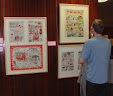
The exhibition itself is almost entirely comprised of mounted original artwork. It’s fascinating to see the way some strips were put together: drawings cut out and glued on to the main sheet of paper, then drawn on some more to make them fit the boxes*; lettering carefully following ruled lines. As you walk in you have Roger the Dodger, Dennis the Menace and The Bash Street Kids to your left: this is all I saw for some time, in fact, being slightly overawed in their presence. The Bash Street Kids strip is one of Leo Baxendale’s: two pages, one drawing on each, masses of detail as the Kids first look through the glass of an aquarium, then jump in and get a hiding from the creatures within. Dennis is riding a stagecoach pulled by a bull in his strip, and again this takes a whole page. On the gallery tour D. C. Thomson archivist Morris Heggie pointed out that Dennis’ face is drawn on top of several layers of white-out, explaining that artist David Law was something of a perfectionist. Which was unexpected, because his lines are always so shaky. A little further on, into the ’70s, we came to a large Dennis drawing from an annual cover – still shaky, but less so. David Sutherland, also present, explained that this was him ghosting David Law, and contrasted it to the far surer line he used (and still uses) to draw The Bash Street Kids, which – initially at least – found him ghosting Leo Baxendale. This quiet old gentleman has drawn the strip for almost half a century and lives just along the road from here. He didn’t want to give a talk, but agreed to accompany the group around, and answer questions.

As we moved on to the 1980s, the lines in the art became surer still – too much so, perhaps. Particularly in the Grandpa and Tom, Dick and Sally strips (both on show), which were never really up to scratch, being too clean cut. Lettering was replaced with type, stuck to the page with glue, and this reduced the hand-made feel still further. Still, it made the impact of Tom Patterson’s more chaotic style all the greater, of which there is one example on display (not Calamity James, sadly). There is much else in the exhibition to love: some fantastic World War II Lord Snooty strips, some early Dennis the Menaces, an incredible Leo Baxendale Minnie the Minx which verges on war itself (rival gang destroys most of Minnie’s gang’s hut but have to pause for lunch; before they come back, Minnie equips herself with a castle). Standing next to the latter, Heggie told us something of the tensions between Baxendale and the editorial staff: the artist wanting to produce outlandish set pieces the whole time, his editors arguing that the strips should be a bit more normal, that kids didn’t want to have their minds blown every week. He likened the appeal of comics to that of soap operas: people like to be comforted. Which I’m sure is right, but it’s the more ambitious stuff which steals the show here.

The exhibition continues until 20th September.


* Apparently this wasn’t typical: the Roger the Dodger strip shown above was drawn for the weekly comic, then re-sized for an an annual. Each individual frame was slightly enlarged.

Saturday, February 03, 2007

Ivan Brunetti (ed.) – ‘An Anthology of Graphic Fiction, Cartoons & True Stories’

That’s the one. It is pretty fine, yeah. There is a contents page, but it only has pictures and numbers – looks lovely, but pretty useless for reference purposes.

The only thing I’ve actively disliked so far is Gary Panter’s ‘Jimbo in Purgatory’. Stuff I do like: Richard McGuire’s ‘Here’ (place stays the same, year varies, sometimes within the frame, lots of intergenerational parallels); Peter Bagge - you gave me some of his comics, I think?; things even I’ve read / heard of like ‘Maus’, ‘It’s a good life if you don’t weaken’, ‘Jimmy Corrigan’; something called ‘Julius Knipl: Real Estate Photographer’ which confused me a fair bit but how can you not love the title?; Mat Brinkman’s ‘Oaf’ which looks like you drew it; a beautiful ‘Gasoline Alley’; a measly one ‘Krazy Kat’; James Kochalka’s ‘Sketchbook Diaries’ which are jangly; ‘Barnaby’; a whole load of ‘Peanuts’ tributes (Art Spiegelman’s is the best) but – so far – no actual ‘Peanuts’; Julie Doucet’s rather lovely (and grotty) ‘New York Diary’. Things progress thematically quite a lot: all the mid-section cartoons are about sex (mostly relationships, some fantasising, some child abuse)... except actually for ‘It’s a good life...’ which is a bit odd. Then they morph into more general diary cartoons. All the funny stuff’s at the beginning – should I be dreading the end?

Does that give you some idea? It’s a nice thing.

A comic expert responds:

Sounds good – This here website might help you in figuring out what is what.

I’m familiar with a lot of it, obviously – it’s all been anthologised somewhere before, usually in the McSweeny’s book from a couple of years ago, but it’s a nice selection. There does seem to be rather too little for me though.

I knew that you’d like both Gasoline Alley (You can get big collection of the dailies called Walt and Skeezix that are nice) and Kolchalka. The latter is jangly because he’s in a big old jangly band, called James Kolchalka Superstar, naturally. I like his superhero comic – Superfuckers. Lots of fun there.

Blog Archive

Labels