Tuesday, August 22, 2006

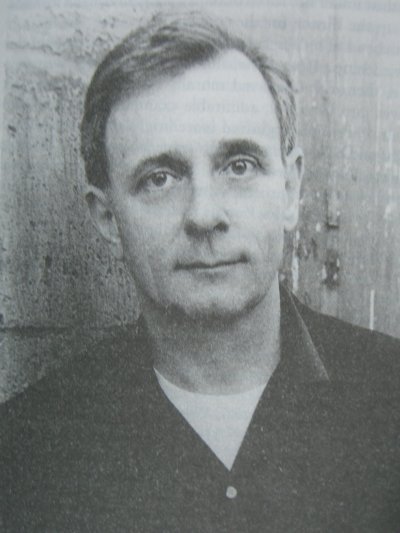
Edmund White - 'My Lives'
I'm stumbling over writing this one, and have now left both the book and the quotations I noted down at my other home (cumulatively, my girlfriend and I have a house, it's just that some of the rooms are five miles away from the others), which doesn't help. And look, in this blog which I'm trying to keep reasonably free of references to myself, how quick I am to mention my girlfriend when discussing an account of a gay life. As if to draw attention to my generous indulgence of this way of living which deviates so far from my own experience. And to reinforce the position from which the indulgence is granted: that of the heterosexual, monogamous male. All powerful, all dull, in the patriachal model of society no-one believes in anymore. Yet as I get older I find myself, hedged in by circumstances which haven't quite gone my way (neither are they completely awful), falling back on this flimsy defence. Because I am English and can construct a sentence. But I don't really want to revert to type, and that's why I need books like 'My Lives' to shake me from complacency.

Edmund's father is rather like that, though he remains unshaken. In another 'Blind Assassin' coincidence, he made a fortune in manufacturing during World War II, only to lose it all afterwards, ending up broken by the inconsistency of the world's favours. Just like Laura and Iris's father. He belives in the practices which have made him successful, to the exclusion of almost everything else (the only real exception is sex). Because he knows how to balance the books and wear a respectable suit, he doesn't bother about people: he has no friends, is devoid of curiosity. His task is to get the things he knows done, not to find out about new ones.

Edmund's mother is the opposite: the tragedy of her life is that she lacks her husband's (later her ex-husband's) certainty. When there's a man around, she doesn't need to supply this herself, and is OK. Studying and working in Psychology also gives her a framework to cling to (as well as supplying Edmund with in-house analysis of his homosexuality, which he sees as a curable disorder all through adolescence). She is curious, to a point - enough to study Psychology, enough to feel a sometimes desperate need for a male companion, but Edmund, whilst clearly very close to her, is scornful of her intellect. It's hard to tell what motivated him to put the following story in his book: once, as a fat alcoholic, she fell in her house and was unable to get up again. She was also unable to empty her colostomy bag and, realising after 48 hours that her own faeces were starting to back up and would poison her if the bag didn't burst, she prayed, promising God that she'd give up drink if he would burst it and save her life. The bag did burst, and she became a teetotaler.

My knee-jerk reaction to this: how disgusting! Demeaning! Why say that about your own mother? Well, partly because it's true, but that hardly covers it. It tells as few other anecdotes could (here's hoping, at least) what kind of a state she was in: it's an effective crux in the 'My Mother' chapter. Mostly though, it's an example of Edmund's rejection of his father's values of order and tidiness. He refuses to tidy up his life, because his life is all about the fascinating mess which occurs when people freely interact. Not when he was (as he still is, of course) living it, and not now that he's come to tell it.

He is equally blunt about his own life, usually in relation to sex. The chapter 'My Master' is a painful account of an affair which began and ended only a few years ago (concurrently with his 'real' long term relationship, and with the full knowledge of his partner). Edmund's account of his retreat to the internet after the break-up, dividing his time between incessantly checking his email (for the 'I'm sorry. I've made a terrible mistake' message which inevitably never comes) and crusing gay message boards, is completely without gloss or glorification. If this seems a little less pungent than the colostomy story, there are details of sex acts with T. (the only un-named person in 'My Lives') which make up the shortfall. Rarely can an elderly man's affair have been so filled with youthful excitement and pain, and Edmund begins the chapter castigating himself for this, as though he hasn't progressed at all since he was 16. But when he was 16 he would have been incapable of writing something as vital as 'My Master'.

There is another side to this abjection. T. is the master, Edmund the slave, the role he has preferred all his life. In giving us so much in his autobiography which might have remained private, he is being both generous and selfish, since what turns him on is to give up power, make himself vulnerable. It's a neat paradox but not, perhaps, an uncommon one. It's also an impulse which, in inviting reaction, draws people in and makes possible a life full of interest and friends.

Monday, August 07, 2006

Mario Vargas Llosa - 'The Feast of the Goat'

There are certain things linking 'The Feast of the Goat' and 'The Blind Assassin'. Both use alternating narratives: one from a very specific strand of the past, the other in the present, reminiscing more generally, filling in the gaps and gradually revealing where the past has led. In both narratives there is an obvious crux: 'The Blind Assassin' opens with Laura Chase's suicide, as she drives dramatically off a bridge, and the rest of the novel is dedicated to explaining this event. Chapter two of 'The Feast of the Goat' introduces the four assassins of Rafael Leonidas Trujillo, dictator of the Dominican Republic from 1930 - 1961, waiting in a car for Trujillo's Chevrolet Bel Air to drive past, so they can pump it full of bullet holes. Roughly half of the novel is dedicated to explaining this event; the remainder deals with the fall-out.

Another point of comparison is the sexual preference of the dominant male presence in each book, for too-young women. In each case the girl concerned is pimped by her own father (in desperate straits) to a more powerful man for financial or political gain. Repression and machismo are constant themes, and the sad conclusion to draw from both is that, though order can be restored, brute force (or its financial equivalent) will often hold sway for so long that it is impossible to entirely recover from its effects. This is particularly true of 'The Feast of the Goat', in which the tyrant's domination affects not just a family, but a nation. The culture it describes is one of reasonable affluence (fast disappearing because of sanctions), but absolute repression. Political murders are common, the media is state-controlled. Trujillo has elevated himself to a God-like status: he owns 40% of the country's industry, and buys more for nominal sums people are too frightened to refuse; he sleeps with whoever he likes, including the wives and daughters of most of his ministers; his personal whorehouse is 'a kitsch monument' (p. 390), putting one in mind of Saddam's gold taps.

And yet, he is hard-working: the country doesn't run itself. This is not a mitigating circumstance, but it does explain a lot. The fear, the devotion. The rest of his family - his sons, brothers and wife - hang on his coat tails, without an ounce of his decisiveness or initiative. They just like being rich, and putting on generals' outfits. Trujillo's undoubted capacity for office is reflected twice through the actions of others: firstly, by contrast with the badly organised assassination (one of the assassins happens to know a trustworthy doctor, for instance, which he mentions after the event, when they are all riddled with cuts and a few bullet wounds - how can they not have thought of this in advance?), and most especially General Pupo's pathetic reaction to it, which shows the power of long habit; secondly President Balaguer's masterful improvisations, by which he manoeuvres himself from puppet president to the real thing. Far more of a politician than Trujillo, he proves adept at keeping enough people happy enough for the country to not break down in to civil war, or be invaded by America.

The most powerful section of 'The Feast of the Goat' comes after the assassination. This is where the structure differs from 'The Blind Assassin': now there is nowhere to go, the plot is no longer inevitable, and messy real life emerges from the clockwork. The remaining chapters each follow the fate of an involved party, truths emerging at their intersections. The quick deaths of Antonio de la Maza and Amandito are the least painful: they come out fighting, and face the inevitable. Amongst the pestilence of black Beetles which descends upon Ciudad Trujillo (Santo Domingo) after the assassination, each containing secret service agents and machine guns hungry for assassins and relatives of assassins. Horrible scenes of torture fill some of the later chapters, and Urania's rape by Trujillo (the novel's second crux) rounds things off, but surprisingly the ending does manage to be hopeful, though it can't be fulfilled. Things have changed. The Goat is dead. It's up to the people now.

Sunday, July 09, 2006

Margaret Atwood - 'The Blind Assassin'

This is the first Margaret Atwood book I've read, having been aware of her for years (of course - she doesn't exactly have a low profile). My sister 'did' 'The Handmaid's Tale' at school a decade and a half ago, and it must have been one of those books, as is the way with secondary schools, that are dwelt on at leisure over the course of a term, in acknowledgement that the children aren't likely to read them any quicker than that. She watched the film at home, which I dimly remember, and my impression was that it was one of those 'Brave New World' type Sci-Fi dystopia books which are so appealing as a child. The collision of the immortality of youth with the prospect of near-Armageddon, I expect: how exciting danger is when you feel it can't harm you.

'The Blind Assassin' is concerned with the deterioration from that point: from youth to age, from love to hate, betrayal, cold revenge and then doomed reparation. Told from the point of view of an old lady with a weak heart (near death, wanting to set the record straight), it draws a thread through the fabrics of present and past, pulling the two gradually together. Feebly, with an old woman's strength, so that it takes 600 pages and a year of writing (she describes the seasons as they pass) for them to meet. The narrative is gentle in its revelations: it signals them in advance, but makes no apology for the things it has kept hidden. Yet it's hardly unreliable: the whole point is to get at the truth of what happened, to unpick the lies of others. The conceit is maintained that this is not a novel but a collection of papers left for Iris Griffen's estranged grand-daughter Sabrina. To explain the estrangement. To explain that it isn't Iris' fault, and to give Sabrina back her history. That it takes such a novel-like form is itself one of several clues-which-don't-seem-to-be which cause the narrative to turn itself inside out along the way.

Sci-Fi finds its way in too. Half the novel (by sections if not numbers of pages) is given over to extracts from Laura Chase's 'The Blind Assassin'. Laura is Iris' sister, an other-wordly, free-spirited sort with an engaging habit of taking grown-ups too literally. Her death at the age of 25 is the event which kicks off the novel, and which it spends most of its length working back towards. She drives off a bridge, deliberately, in Iris' car. Her only legacy is her novel which, published posthumously, scandalises the local community of Port Ticonderoga, and precipitates a second suicide. In it, a couple meet for sex and stories at a variety of run-down locations. Both of them have severe constraints: he is on the run from the police (which is why he keeps moving), she is married. The reader is left to assume that the only highlight in either life is this series of meetings, which constitute the whole action of this novel-within-a-novel. Nothing is said of why the man is a fugitive, and very little of the woman's husband. The only time that matters is the time they spend together, and this is typical of Laura: her instinctive grasp of what's important leads her to ignore all the in-between stuff (money, propriety) which occupies her sister and most of the rest of us to a greater or lesser degree. Iris comments on this: that she is practical whilst Laura is not, and yet it was Laura who drove her car off a bridge, the ultimate practical action. She thinks she - Iris - would not have had it in her.

To begin with, most of these meetings - at least the parts we're told about - are taken up with the man's Sci-Fi stories. He makes them up on the spot, and she interjects when he makes a mistake, or is unwarrantably harsh to his characters. This is what he does for a living too: from his hide-outs, he types up reports from foreign worlds and submits them to magazines, who accept them from time to time and send out a cheque payable to one of his roster of pseudonyms. In this way he scrapes by. The stories he tells are violent and cynical. There is war, pillaging and destruction. The city of Sakiel-Norn is burned to the ground by the Lizard Men of Xenor. But before this happened Sakiel-Norn was plenty brutal on its own account. The main story (a monologue within the novel-within-a-novel) centres around a cruel custom the city has of sacrificing maidens, and a plot which is hatched to attack the regime responsible. The blind assassin of the title is to kill one of the maidens on the night before the sacrificial ceremony, and take her place. During the ceremony he will kill the High Priest and trigger a military coup.

Not surprisingly, this assassin is important. His blindness is literal: he knows exactly what he is doing, has been so worn down by the way society has treated him that any sense of moral responsibility has been lost. The blind assassins are a caste: used as slaves to weave beautiful rugs while young (while their fingers are small and nimble enough), they are tossed aside once this activity has destroyed their sight, and many drift - why not? - into contract killing. Iris, too, has her youth taken advantage of, worn away, and she too becomes a silent, unsuspected, deadly adversary. As an attractive young woman she is a member of an unacknowledged caste, to be used, by rich men in search of wives. A wife serving a double purpose: she will confer respectability, the appearance of social success; she'll also be something to fuck. Her equivalent of the killer's blindness is her inability to make decisions, at least at surface level (Richard and Iris' marriage is all about perception from the outside). The marriage is run by him, and his sinister sister Winifred. Iris has to resort to subterfuge if she's to exist at all. This she does and, whilst she does end up damaged, she is able to regard past events with remarkable equanimity. She outlives everyone who beset her, but also everyone she loved.

Sunday, June 25, 2006

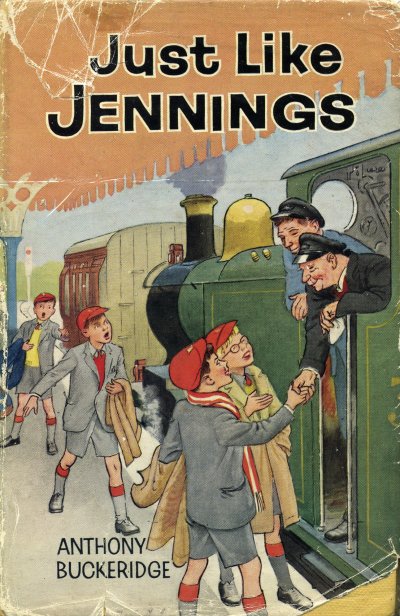
Anthony Buckeridge - 'Just Like Jennings'

I used to love Jennings books. The ones I had were '80s paperbacks with photos on the covers which made me wonder if there was a TV series I'd missed. If there wasn't, then why did they go to the expense of getting actors to pose? If there was, why didn't it say 'Now a major BBC TV series' on the front? And why was it never on TV? This copy of 'Just Like Jennings' looks nothing like the ones I remember. A hardback from 1961, a first edition even, which cost all of £6 from an Oxfam book shop. Its line drawn illustrations aren't something I remember, and I'm fairly sure they didn't appear in my paperbacks, perhaps because they didn't fit the almost-a-TV-series image. They have a freshness and an innocence which say '50s rather than '60s. They don't smack of franchise.

This isn't the first Jennings book I've read lately, and for this reason I can't get too excited about it. It's enjoyable enough, and does have in it some of the wonderful convolutions which make Jennings so great - such as the episode in which (deep breath) Jennings becomes convinced he's on the trail of a criminal mastermind because he's seen a man out birdwatching with some sophisticated equipment. Lacking a magnifying glass, he borrows the lens from a slide projector and smothers large areas of the school in chalk dust - not in a direct attempt to catch his man, but more because he's caught the detective bug and likes the attention. He and Darbishire do make an attempt to get the suspect's finger prints (by covering a pop bottle in chalk dust and pretending they can't open it - at least this is the plan until they notice, with relief, that he's wearing gloves). This makes them late for roll call, and some teachers amble along in search of them . They come across the bird watcher too, realise he's rather a distinguished fellow, and invite him to give a talk to the boys. The talk requires a projector, the projector requires its lens back... there's plenty of confusion to be had here, and Buckeridge uses it to good comic effect.

The problem is that this is only one of four stories which occupy the term, and the two which follow don't quite measure up. They certainly don't measure up to 'Jennings Goes To School', the other one of the series I read recently, which was hilarious all the way through: as funny, it seemed to me at the time (perhaps affected a little by nostalgia - but not too much) as any Wodehouse novel, and in much the same vein, but with school masters instead of aunts. This one sort of peters out, which is a shame.

Saturday, June 17, 2006

'Out of the Past' (Jacques Tourneur, 1947)

The dark, the light. The night time drive during which gas station manager Jeff Bailey brings his small town love Ann up to speed with his past life as a PI; the sunlit scenes by lakes and rivers, and in the dusty town itself. Out in Mexico, the dark of the bars, the light of the hotel at breakfast. Perhaps it's not so surprising: there are twenty four hours in a day, and Robert Mitchum seems to suit all of them. Whit Sterling, a big bad 'businessman', has Jeff hunt down his girl Kathie, who's run out on him taking $40,000 with her for company. 'What'll you do when I find her?' 'I won't touch her' - this is the lip service they pay to propriety, but it's clear from Whit's aggressive manner that he's not to be believed. Whit also says he's hiring Jeff because he trusts him, a claim he repeats several times in the film, and each time it's more ludicrous. Jeff's not to be trusted, and Whit knows it. He's a law unto himself, neither on the side of good nor evil, but nonetheless with an unpredictable integrity all his own. So he finds Kathie, falls in love, takes her for himself. Or is it she who takes him? And would that be because she wants to stay out of Whit's reach, or because she falls in love back?

Kathie doesn't have a program, is just as unpredictable as Jeff, but entirely lacks his integrity. As the film progresses she kills nearly every major character in an attempt to a) ward off the authorities and b) get Jeff back (and b) often seems like a convenient way to consolidate a).) She's ruthless, but without direction. She draws Jeff back to her when Whit brings him back into the fray (he'll be useful as a fall guy), and clings on to him until she's destroyed them both. Ann, the good woman who loves him, doesn't stand a chance, and the first time we see them together (romantic, lakeside, carefree) is the last time we see them together and happy. He eventually dies trying to hand Kathie over to the police, and afterwards we see Ann talking to Jimmy, Jeff's deaf mute garage assistant, who tells her that Jeff was running away with Kathie. It's not true, but it releases Ann from the clutches of his memory, clutches which are Kathie's by proxy.

By proxy is how femme fatales operate, of course: they can do nothing without the adoration of men who should know better, or men (like Jeff) who do know better and get sucked in anyway. I saw the film not as a crime caper (though there are plenty of dirty deeds) but as almost an allegory, about the dangers of falling in love with someone you shouldn't have. 'Almost' because this actually does happen to Jeff in the film, but for most of us this kind of bad choice doesn't result in intrigue, murder, fleeing the law. The mood it conjures up by its noir devices (of tension, despair, fleeting hope dashed, nerves frayed but alive) is equivalent to the kind of thing one might go through, being besotted in the wrong direction, with a tender object who is just interested enough to keep one dangling.

This is what the film does so well: it shows the power of a woman's beauty, and the incapacity of either the woman herself or the entranced man to deal with it. It shows the moral choices which emerge under such circumstances. For her: how far to exploit her power, how far can she even see past her reflected glory to judge the extent of any real reciprocated feeling? For him: how far to let himself be exploited, how far to let his love eclipse the world? Such choices are so contingent on circumstances beyond the control of the (dis-)interested parties (like Whit's calling in of Jeff after ten years, itself dependent on the large sign over Jeff's gas station which bears his name and gets spotted by one of Whit's henchmen) that they barely amount to choices at all. All they can do is wipe themselves out.

Blog Archive

Labels