Sunday, June 17, 2007

Yukio Mishima - 'Confessions of a Mask'

This has a remarkable cover:
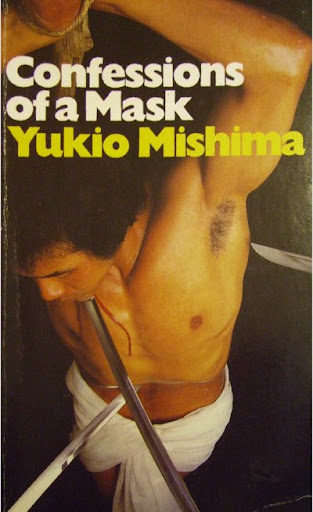
Confessions of a Mask front cover

There is no way I'd have bought it if it hadn't been by Yukio Mishima and 30p. Talk about over-literal ham fisted imagery. The date? 1972, 1977 or 1985, are the publication and reprint years, take your pick. I'm going to guess 1985. If the front weren't bad enough, check out the back:
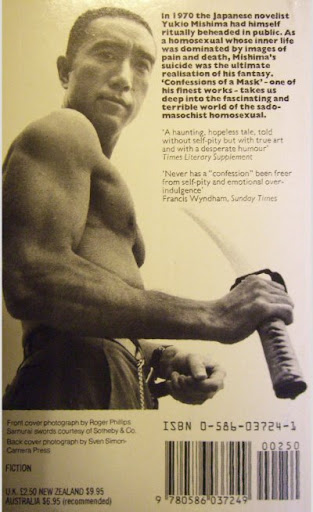
Confesstions of a Mask back cover

Now, whilst it would admittedly be tricky to write blurb about Mishima without mentioning the impressive suicide, here it's too prominent, surely? People don't read him because of the way he died, do they? And yet, having read it, the cover has begun to seem fitting. The man hanging there impassive to the swords, maybe even asleep. It isn't quite true that the book 'takes us deep into the fascinating and terrible world of the sado-masochistic homosexual': there is no sex of that nature here, nor much of any other nature. Nor is there very much focus on homosexuality, beyond a brief infatuation for Omi, an alpha male at school, and references to the narrator's 'bad habit' (frequent masturbation). Increasingly as the book continues, it becomes the elephant in the room as he tries to convince himself that he loves Sonoko - indeed, he does seem to love her, just not in a sexual way.

As I travelled toward N Village, along with every jolt of the train came the torment of a childish and pathetic obsession: I was determined that I would not leave without kissing Sonoko. My determination, however, was different from that feeling filled with pride which comes when a person struggles to achieve his desire in spite of timidity: I felt as though I were going thieving. I felt like a fainthearted apprentice in crime who was being coerced into becoming a thief by the leader of his gang. My conscience was pricked by the happiness of being loved. Or perhaps I was craving some still more decisive unhappiness. (p. 157)
This self-analysis is quite typical in its dryness and perspicacity, and is reminiscent of Proust (who gets name-checked, being described as a sodomite, as though this were his chief point of interest) in the way it shifts around: it is only certain that there is a strong emotion, and what the emotion is is open to endless interpretation.

The story is set before, during and after the Second World War, and in it the narrator can see a glorious death solving all sorts of awkward problems. From Mishima, this comes as no surprise at all, one only has to think of Isao from Runaway Horses. The character from The Sea of Fertility the narrator most resembles, though, is Toru from The Decay of the Angel. At least in the early stages of the book, he openly uses people and manipulates them, he is totally alone and he likes it that way. When the prospect of an early death fades, he mellows, becoming far more likeable. This I did find unexpected, but it was completely believable. The intensity of youth dissipates and death no longer seems glorious: he manages a kind of friendship with Sonoko, and as the book ends he finds himself attracted to some muscular young men with no shirts on at a table outside a dancing club. A happy ending, no less.

Sunday, June 03, 2007

R. Crumb and Peter Poplaski – ‘The R. Crumb Handbook’

Boy is this rude. And thoughtful, in an anxious way. In one of many mini-essays, this one called ‘The Litany of Hate’ (pp. 386-7), Crumb lays waste to the human character and the modern world (‘I hate cars. I hate modern architecture. Every building built after 1955 should be torn down!’) He even despises his own sexual impulses:

I was always repelled by my own sex drive, which in my youth, never left me alone. I was constantly driven by frustrated desires to do bizarre and unacceptable things with and to women. My soul was in constant conflict about it. I was never able to resolve it. Old age is the only relief.

He coins it even more neatly in conclusion: ‘”Hell is other people” – John Paul Sartre. “Hell is also yourself” – R. Crumb.’ It’s hardly a surprise that he feels this way, having just waded through 385 pages of secretions, but it’s also obvious by this point that it’s this sexual energy and his own ambivalent attitude towards it which is Crumb’s greatest asset in his cartooning. There was a decent selection of his stuff in the Ivan Brunetti anthology I read a while ago. One cartoon had him mooching existentially, and the drawing was a bit lifeless until he got himself down to the university and found an amply proportioned student to chat up. Immediately he had some tits to draw, the art picked up. Nobody draws nipples like Crumb.

John Boorman tried to escape from modernity (and to take it on) by retreating to the Amazon, and to his own boyhood. Crumb goes further back: he knows his own childhood came too late, was swamped by the mass media just as happens today. So he collects ’78s, and escapes to a time before rock ’n’ roll or (heaven forbid!) pop. He knows this is just a gesture though: his work is (as he says) a response to being brought up on TV and comics. The mass appeal slop that has stretched from his youth until now. He struggles against it, but from within it. It is a part of him, as much as his sex drive. He has no calm memory of semi mystical affinities with rivers, as Boorman does. He’s ten years younger, which will be a part of it, but also American, where this mass media slop was developed. There is no escape.

Quentin Crisp’s definition of a stylish person is someone who ‘swims with the tide, but faster’. This is what Crumb does with American culture. He sees the emptiness of promising people what they want (as long as it is TV or convenience food), and asks: what if you give them what they really want? Which is, to do bizarre and unacceptable things with and to women (and / or men). Hence ‘The Family that LAYS together STAYS together’ and ‘Joe Blow’, deliberately anaemic stories about (guess what?) incest. As far as I recall, there wasn’t anything actually pornographic in the Brunetti selection. This is rectified here. There’s a definite thrill in the absolute abandonment of propriety in Crumb, but crucially it is never about the abandonment of morals, only of proscribed behaviours. In a strip called ‘On The Bum Again’, the elderly and white-bearded Mr Natural finds himself on a train with an abandoned baby. At least, she’s referred to as a baby and has a baby’s hat on and a dummy in her mouth, but is otherwise she appears to be fully grown. They leave the train by a window and end up in the middle of the desert. Baby gets hungry. What’s the only fleshy nozzle capable of producing a milky white substance available? Yup, you got it. Why is this not morally suspect? Because… well it is, I suppose, a bit. But it’s a flight of fantasy, it’s not a real baby (she’s ‘a caricature of one of Crumb’s girl friends from his hippy days’ (p. 260), according to Poplaski), Mr Natural appears to genuinely believe he’s helping out, and the clear intention here is to wind people up. That sound pretty flimsy? The joke wouldn’t work if it weren’t.

John Boorman – ‘Adventures of a Suburban Boy’

Is this the ugliest Faber book? Usually they’re so pretty. This one, at least in paperback, uses a tiny font size, has photos in amongst the text on bad quality paper, and the cover, oh dear oh dear. Ugly superimpositions, coloured-in black and white photos, and worst of all – Boorman on the back attempting to pull Excalibur from a stone. Reading it at work surrounded by Sci Fi and Fantasy types, I felt distinctly uncomfortable lest they nod in approval. Talking to one of the more cultured ones last week about the new Pirates of the Caribbean film, he asked what kind of films I liked, and when I said I didn’t like Sci Fi, he assumed I must like Fantasy instead, because what else is there? Perhaps it was just the context of the Pirates conversation that made him think that. And is this why the film is so bad? Because it’s tipped too far away from buccaneering towards Fantasy? Reckon so. There are some OK jokes in there, and Johnny Depp is good of course, but the plot is all spurious mythology and I wasn’t able to hold even a single strand of it in my bored head from one scene to the next.

None of this is John Boorman’s fault. His autobiography is full of interest: funny stories, funny characters, and very nearly a sense of purpose. I’m tempted to say that the earlier sections are more vital, but maybe it’s just my snobbery (see above) kicking in: I couldn’t help feeling disappointed when the Sci Fi dystopian Zardoz crawled into view, and very nearly got followed by The Lord of the Rings. There is still great stuff to come after this point (about two thirds of the way in), like the diary extracts during research for 1983’s The Emerald Forest in which Boorman visits the Kamairan Indians in Brazil (I think it’s Brazil – somewhere in the vicinity of the Xingu river) and finds the tribe as divorced from the modern world as could possibly be wished. Hope and Glory, the last major film to be covered here, also sounds tempting, but the description of its making is not as good as the description of the events in Boorman’s own life upon which it is based. This is the pattern of it, perhaps: an early and untutored sense of the rightness of certain things in nature (rivers, trees, kingfishers), followed by a career attempting to capture this sense on film, through realistic means and fantastical.

The best story here involves Lee Marvin and a roof rack, but there are many others. Marcello Mastroianni eliciting sympathy for all the beautiful mistresses he is obliged to endure, Toshiro Mifune attempting to play Hell in the Pacific for laughs when someone gives him the wrong version of the script, or James Dickey (author of the novel upon which Deliverance is based) in general, being fantastically fake, confiding to everyone he meets that ‘it happened to me, you know’. The balance is all on the side of Boorman’s film career, as might be expected, his personal life being covered in asides or when it relates directly to the films. His attempt to write a film about the breakdown of a marriage after the kids leave home whilst this was actually happening to him, and to actually write it with his daughter, appears to spring from the kind of motivation which drives… I don’t know, Daniel Johnston, Robert Crumb… people who translate their life into art almost directly, with no filter. It’s not a trait one would usually associate with a film director, the cumbersome nature of film making not lending itself to this kind of directness. How could this impulse survive the scrambles for funding, the re-writes, the marketing? In this instance (Where the Heart Is, 1988) it doesn’t, but it sounds as though, in Hope and Glory, it might have made it though. Must see it soon.

Sunday, May 20, 2007

Miguel de Cervantes – ‘Don Quixote (Second Part)’

When the first half of a book is episodic, with little story arc except ‘they go away, they travel, they come back’, one might think there’s no point in producing a second half. I’ve read very few picaresque novels, but can’t imagine that, say, The Expedition of Humphry Clinker would benefit from a second part as long as the existing novel, in which the same expedition is undertaken again. That Don Quixote pulls off this trick superbly well is probably the reason it is still read today, so it’s not exactly a surprise to find that it does so, it’s just surprising that it’s possible at all. The more so, as the first part is substantially padded out, the humour of Don Quixote and Sancho Panza taking a back seat after the first (hilarious) 200 pages in order for some complicated romances to take the stage. These, as I mentioned previously, the reader would do well to treat as an ad break, or a romantic interlude in a Marx Brothers film: it’s a chance to get your breath back. ‘Surely you weren’t expecting this pace to continue?’ the book seems to say. ‘Don’t worry, there’ll be more nonsense before we’re through’.

The second part of Don Quixote is the same as the first in that it features the same two characters having the same ludicrous conversations and pursuing the same vague goals (looking for chivalrous adventure, attaining the love of Dulcinea). They leave their village only weeks after returning to it at the end of part one, and pick up where they left off. Cervantes seems to have felt keenly criticisms similar to the one I made above, and doesn’t interpose any unrelated stories this time: it’s all about Don Quixote and Sancho (hurrah!) Occasionally, to really spoil us, it’s just about Sancho. On balance, it’s a funnier book, though it never quite reaches the hilarity of the opening stretch of part one (reading Sancho’s description of Dulcinea I laughed so much it hurt). It’s a better book too, and not just for the jokes.

The most striking thing about part two is the extent to which it is a reaction to part one. The first part was meta fiction because it is a book about other books; the second is more recursive still, being also a book about the public reception of the first part of itself, and about (and against) another book called The Second Part of the Exploits of Don Quixote of La Mancha, written by one Avellaneda in the ten year interim between Cervantes’ two volumes. Practically all the adventures in part two happen as a result of Don Quixote and Sancho meeting people who have read part one and who want to see how mad they really are. Adventures are constructed for their benefit, and they never suspect, Quixote taking them as proof that his delusions are true. Sancho gets to govern his long-promised ínsula, or island, and he glosses over the fact that it is patently inland, being one of the villages on the estate of a duke who goes to quite extraordinary lengths to get the pair to behave like lunatics.

There is a lot of glossing-over in Don Quixote, Cervantes taking advantage of the fragile state of reality to explain away what are almost certainly plot holes in part one: the theft of Sancho’s donkey, for instance, which the reader only discovers when it is mentioned that he is on foot, or the existence of Dulcinea of Toboso, which seems to hang on conflicting testimonies from Sancho. Of course she doesn’t exist as Don Quixote imagines her, and it’s always doubtful whether she knows him and whether she – a young maid – would ever take a husband of Quixote’s age and physical (and mental) disadvantages, but the ease with which Sancho convinces him that a peasant girl he picks at random is Dulcinea enchanted more or less proves that she is only imagined.

The second part benefits greatly from the familiarity of the characters. Though they are fundamentally unchanged from part one, the fact that we know them and are fond of them gives Cervantes the confidence to let them run riot over the whole of the book’s length, and also to fit them to adventures which he might previously have left to his romantic leads. Don Quixote’s hallucinations in the Cave of Montesinos are one example; Sancho’s governorship another. Both characters are now strong enough to cope with something more than episodic buffoonery. Even Sancho’s alteration during the governorship, into a wise governor, is just about within the bounds of what we are prepared to accept. Cervantes strings together a series of Solomon-like decisions which he is called upon to make, in order to sort out disputes between his subjects. The notes show that none of these is original, but to have Sancho giving this wise advice is strangely affecting: the duke is trying to make a fool of him, but he does rise to the challenge, he is wise when the occasion calls for it. Perhaps because he is such a chancer himself, he understands the mentality of the chancers brought before him.

Wednesday, May 09, 2007

Ronald A. Knox – ‘The Viaduct Murder’

Just a short entry, ’cause I didn’t much care for this, but I did finish it, and also I took some photos of a viaduct at the weekend and it’d be a shame not to use one here. If you’ll excuse the pun, there’s just no body to this book. Characters all speak in the same way (generally starting off, ‘I say’), and it’s too self aware. Knox’s rules for writing detective fiction intrude at every step, even breaking explicitly into the narrative on occasion. Mostly this happens near the beginning of the book, then on one occasion near the end, as though he’s consulted another set of rules and remembered he’d forgotten about them, but couldn’t be bothered to go back and amend anything in between. It reads as though it was written in one draft, all its ingenuity being reserved for the plot. And I’m afraid I’m not one to give two stuffs about the plot ingenuity of a murder mystery. I like a Sunday evening in with a cocoa and a Poirot as much as the next tired person, but I never follow the bloody things.

Having said that, this bit is quite good:

‘...a man with a documentary hypothesis can defy the rudest assaults of common sense.’

‘How does one do that, exactly?’

‘You have to start out saying, “This document consists of three parts. One part is genuine, one part is spurious, the third part is faked evidence put in to make the spurious stuff look as if it was genuine!” Then, you see, you are on velvet. You reject altogether the parts of the document which you don’t like. Then you take the remaining part, and find that it still contains a certain sort of dross – evidence which still conflicts with your theory. That dross you purge away by calling it a deliberate fake. The watch says 4.54 – that is proof positive that, in the first place, the murder took place at 3.54, and, in the second place, the murderer tried to pretend it didn’t. You see the idea?’ (pp. 241-2)

Blog Archive

Labels