Wednesday, May 22, 2013

The Pastels — ‘Slow Summits’ (Part Two)

The Pastels, Fire Engines and Strawberry Switchblade
On Monday, the ever-wondrous Pastels release their first LP since 1997; or since 2009 via 1998 and 2003 depending on what you include. It’s an event, anyhow, and it’s been interesting to watch the build-up of publicity, from the celebratory localism of the ‘Check My Heart’ video, to the radio coverage and interviews in the press and online. The day before their interview, 6 Music repeated The Pastels’ 1997 Peel Session, and that’s been a great discovery for me, having missed it the first time around. Familiar songs made unfamiliar, lit from different angles, including a version of ‘On The Way’ which blows the previously muted song — the most curious corner of Illumination — wide open. This and ‘Ship To Shore’ anchor the session to Aggi’s mysterious, haar-like voice, making a fitting send-off for the soon-to-depart bassist and founder member. Listening to the 2013 Pastels against the 1997 model is to hear a band who have left behind the great fog of sound they surrounded themselves in then; they’ve come inland, on a road trip perhaps, from the coast to a mountain top. There’s been a shift towards melody and pop, but it’s a shift that can still take in swirling instrumental passages, and the record is full of joy, light, wistfulness, tenderness. All the good stuff. What follows is an interview I did with Stephen by email in January, as a way of providing some background to my press release, which he and Katrina gently nudged in the right direction through several drafts without hijacking it in the least.

First, the questions, which I apologised for at the time, and which still don’t seem very good. Their elbows stick out all over the place:
  1. What made 2012 the right year to finally get this record made?
  2. Your previous few records have been very calm and beautiful; Slow Summits seems to shake things up a bit, where did that come from?
  3. ‘Check My Heart’ is going to be a single, isn’t it?
  4. How important were the collaborators to the sound of Slow Summits?
  5. I’ve wondered before about the city / countryside tension on your records; here there seems to be a night / day tension as well. Which is best?
Over to Stephen:

I think the questions are extremely helpful, actually. I’ll try to answer them while probably responding to certain parts of the press release too.

1, 2, (5).

It’s not really the case that Slow Summits could have happened at any time since 1998, in fact if the record had been recorded in any one of those years it would have sounded completely different, and been much shorter too! Songs arrived at different times, only ‘Secret Music’ and ‘Slow Summits’ (which was ‘Slowly Taking Place’) go back to that period after Illumination which I think is documented on a John Peel session [from 1999, not the one referred to above]. Being able to work in different situations with The Last Great Wilderness, Do I Mean Anything To You... and Two Sunsets was really useful for us in terms of artistic momentum and the type of music we felt was needed for the film and theatre productions (calm and to an extent, beautiful) was the kind of music we wanted to make anyway. Really that was the common ground we found with Tenniscoats too.

From the start, in the sessions for this record, we had a sense of wanting to do something else too. To maybe make music that could move quickly from one feeling to another. So, we set out to make a record with a bit more production and not to always just let things take place. We didn't try to go against that but we tried to be exciting and unexpected too, to mix up our styles. We asked John McEntire to ‘produce’ if he felt it was ever needed, and Bal Cooke (our Glasgow sound engineer) too. Most of the sessions were quite concentrated and took place over a few days but the overall timescale was probably unusually long and the sessions were all a bit different from each other (places, personnel, other factors). In the end, in compiling it we emphasised some of these changes so that the record has clear contrasts (day and night, city and countryside, calmness, the wild moment) and maybe a bit of the oddness of records we love like The Faust Tapes, Swell Maps In Jane From Occupied Europe and Brian Eno’s Another Green World.

3.

‘Check My Heart’ is going to be a single.

4.

Collaborators were extremely important to the record but it starts from us. We’ve got an extremely good group at the moment and I hope that comes through. I think The Pastels is always a group sound. We wanted the record to have a real sense of propulsion and in the beginning we were able to invite Stefan Schneider and Ronald Lippok from To Rococo Rot to play on the first session. In a way this established a style of having Katrina and one other drummer, which in later sessions was usually John McEntire. Gerard [Love] and Tom [Crossley] probably contributed most in terms of ideas and time spent with us working on the record; both are so inventive and unique. And John [Hogarty] joining the group was great, he’s just a really exciting guitar player. Alison [Mitchell]’s got a very particular soulful trumpet sound. And Norman [Blake] was there some of the time too, he's contributed so much to our music over the years, and helped a lot on ‘Summer Rain’. It was important for us to have Annabel [Wright, previously Aggi] singing on the record and as soon as she was on ‘Secret Music’, with the sound of her voice, it brought a sense of completeness to the record. That was one of the most emotional moments.

Craig Armstrong’s arrangement for ‘Kicking Leaves’ was a massive anticipation. We left the song quite empty but with little bits of production here and there, so it was so thrilling when he ran it with his gorgeous parts. Also, so great to be there for the recording with the string section.

Finally, it has to be said, John McEntire is an incredible engineer and musician. He was an extremely important collaborator, and Bal Cooke too. Both stepped in to play things when needed, unegotistical, great team members.

[That’s the end of the interview bit, and he went on to make a few specific suggestions about the press release. I wanted to include the following, even though it refers to possibly the most misguided thing anyone has ever attempted to say about The Pastels, because it takes in, too, the love that they are all about: the plain, ordinary kind, extrapolated to take on the whole dizzying world.]

And I have to say, I am a bit stumped by the blaxploitation reference in ‘Night Time Made Us’ [I was trying to compare it to Curtis Mayfield, and missed]. I think you really had the essence of the song with what you said about your grandmother [she died not long before I first heard the song; hearing it again, it made me think of her, her old house, her paintings]. For me, it’s about growing up and being protected by the love of my parents and the influence they had on me. But it's about also knowing I had to move out from that to find other things. The excitement of warm summer nights and the chilling anticipation. It’s my main memory of being a teenager.

____________________

Domino’s Slow Summits page.
The Pastels’ website.
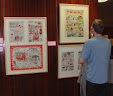
The What Presence! exhibition, now at Dundee’s McManus Galleries, where you can see the triptych above.

Tuesday, May 14, 2013

Tom Doyle — ‘The Glamour Chase: The Maverick Life of Billy MacKenzie’

Poor Yaki. And Paul. But most of all, poor Billy. ‘Billy’s dead,’ I said to S., mournfully, as we set off on Sunday afternoon to look at pictures of him and others in Harry Papadopoulos’ fantastic What Presence! rock photography exhibition, which has now rolled around to Dundee’s McManus Galleries. We were roughly opposite Bonnybank Road (where the MacKenzie family once lived) as I said this, though that wasn’t deliberate, and had walked along Lyon Street (cf. the short-lived Associates spin-off group 39 Lyon Street) a minute or two previously. So many landmarks in The Glamour Chase are five minutes’ walk from my flat, it’s an odd feeling. ‘He has been for some time,’ said S., not unkindly, to bring me back down to earth. I know it’s spurious to claim any kind of connection based on shared geography, especially with (of all the clichéd things to identify with) a rock ’n’ roll suicide, so I won’t, but still, having just finished this splendid book, I do feel a little as though Billy’s spirit haunts this place. ‘He was alive an hour ago,’ I protested. That’s the magic of biographies, isn’t it? By telling the stories that make up a life, they do something much more powerful than fiction’s suspension of disbelief: a good biography will reverse the fact of death, for a while, at least.

To tie in with What Presence!, there was a screening on Friday of a TV documentary based on Tom Doyle’s book (also called The Glamour Chase, you can watch it on YouTube), followed by a Q & A with the author. Doyle came across as garrulous verging on incoherent, beginning every answer to Lorraine Wilson’s questions, ‘Yeah, totally,’ and proceeding to not really think about what he was saying until he was three quarters of the way through. It wasn’t a bad effect, necessarily (he was warm and enthusiastic), but surprising nevertheless in someone who writes books. After that, still having half of it left to read, I kept noticing straggly sentences with too many clauses, and phrases which didn’t quite say what they were obviously supposed to mean. Neither of those tendencies make Doyle a bad pop writer: on the contrary, he has a bullish way of interpreting Billy’s actions that cuts through the mystery / bullshit and always gets to the funny side if there is one (there mostly is). He stacks anecdote upon anecdote until you’re left with the left with the impression that here was a mind like Captain Beefheart’s: autocratic, wired to make life the absurdist artwork, unable to even consider practicalities like cooking, money or record contracts. He gives a balanced account, too, of Billy’s artistic achievement, picking out successful songs on unsuccessful albums during the mid to late ’80s, keeping a tally on the number of years without a hit, and the unbelievable sums WEA and then Circa paid out for these records which didn’t sell (it works out as over £250,000 each for four albums, one of which wasn’t even released, and the last of which sold around 3,000 copies). So Sulk is the masterpiece, as everyone knows, and the posthumously released work with Steve Aungle the return to form.

As the documentary wraps up, the various talking heads (Siouxie Sioux, Marc Almond, Martin Fry) pay tribute to Billy’s talent, but Alan Rankine takes a different tack: ‘I’ve had a hell of a lot of laughs in my life so far, but I’ve never laughed as hard as I did with Bill’. The stories in this book are just great: the early jaunts to New Zealand and Los Angeles, getting married at seventeen in LA so as not to lose a job chopping onions at a hot dog stand. The punks who gobbed on the Associates during a gig, and ended up on the receiving end of Billy’s ability to projectile vomit at will (powered in this instance by vodka and blackcurrant juice, swigged for the purpose); or the other vomit story, of the ‘restaurant crawl’ in Paris, Billy claiming that by eating and then throwing up the food of all these swanky places, he was absorbing the best nutrients on earth. There are the record company scams, beginning with the Associates’ first single, ‘Boys Keep Swinging’, intended to attract the attention of David Bowie’s music publisher, as they hadn’t sought permission to cover his recent single. Later he would charge just about everything to the record company’s account, like a Holiday Inn room for his beloved whippets, or a taxi from London to Dundee when he was finally dropped from WEA. There’s a lovely portrait of domestic oddity from the time he and Steve Aungle shared an Edinburgh flat in 1994, in order to concentrate on their songs. There were ‘no pots and pans in the kitchen, only a champagne bucket’, which makes even less sense of this:

both found themselves sonically addicted to the soothing qualities of the ‘pinging’ sound emitted from the timer on the old-fashioned cooker in the kitchen. ‘It was just this hypnotic ping that you could hear from any room in the house,’ the musician remembers, ‘and you got so used to hearing it, if it stopped and we were right in the middle of something, I’d go, “Oh, the pinger’s stopped” and Billy would run down and put it back on again. [...] Then, Billy used to try to get me to make all the tea. He said, “Steve, you might think this is a bit weird, but I think the kitchen’s malevolent and I can’t go in there any more.” (pp. 192-3)
A daft note to end on, but if this biography is anything to go by, he was as daft as he was amazing.

Tuesday, May 07, 2013

Olivia Manning — ‘Friends and Heroes’

On the train to Bucharest, she had watched him surrounded by admiring Rumanian women, his face alight as though with wine, his arms extended to embrace them all. To someone so enamoured of the general, could the particular ever really mean anything? (p. 168)
Friends and Heroes, book three of the Fortunes of War series, continues the story of a marriage made in haste and regretted under fire, the boredom and the terror of war prompting disillusionment and then renewed affection between Guy and Harriet Pringle. He is as much of an extrovert as a bookworm can be; she as much of an introvert as a woman in search of adventure can. The backdrop is the Second World War of the non-combatant ex-patriate British community, in Bucharest and then, when Rumania falls, Athens.
She had once accused him of considering her feelings less than those of anyone else with whom they came into contact. Surprised, he said: ‘But you are myself. I don’t need to consider your feelings.’ (p. 177)
Guy is more aware, and clever, than Harriet gives him credit for, though perhaps that wasn’t the best thing for him to say out loud. He’s an English teacher, and an inspired one, with an infectious enthusiasm for his subject. At the drop of a hat he will put on a play or a revue, he’s always at the centre of things, and absolutely selfless. Harriet comes to see his generosity, which is genuine, as a limitation: it is so universally applied that it amounts in the end to a lack of ambition, and of focus in general. It means that he will fritter away his talent.
They had learnt each others’ faults and weaknesses: they had passed both illusion and disillusion. It was no use asking for more than anyone could give. (p. 309)
Harriet, who quickly tires of the company whose approbation lights up Guy’s face as though with wine, marvels that she has married someone so different from herself; but by the end of Friends and Heroes she appears to have got over her little almost-fling with a soldier and accepted that, for better or worse, Guy’s side is where she belongs. Her extreme affection for a cat near the end of the novel* seems like a compromise: she knows she won’t get the particular attention she needs from Guy, but she no longer considers being unfaithful an alternative.

It isn’t all about Harriet and Guy, though. Yakimov, that prince without capital, so selfish and so endearing, faded, ineffectual, an extraordinary comic character, having endured most of Friends and Heroes delivering news sheets by bicycle (an improvement on his previous destitution), meets his end pointlessly. The final section of the book is called ‘The Funeral’, and I’d been hoping the insufferable Lord Pinkrose would be its subject, but no.
There would be no one left who had known him in life or remembered that the scraps of cloth lying among his long, fragile bones, had been a sable-lined greatcoat, once worn by the doomed, unhappy Czar of all the Russians. (p. 315)
Poor Yaki.
____________________

* This is not the first cat which has been important to Harriet, and one also crops up, again providing a substitute for human affection, in Manning’s School for Love.

Thursday, April 18, 2013

Paul Eddington — ‘So Far, So Good: The Autobiography’

I made the mistake of reading this just before going away on holiday, without it, so I shan’t do a full review. If you have about you any fondness for Paul Eddington, though (and why wouldn’t you?), this is a great read, and surprising in several ways. One is the extent to which he was a theatre actor as opposed to a television actor. Another is the year of this book’s publication, 1995, the same year that he died (given the title and the presentation, it can’t have been posthumous). A third is the way it is told, which, to be critical, might be said to lack dynamics: the book is largely a string of theatrical anecdotes, put into chronological order, with little space devoted to anything more personal. Marriage and children are mentioned as they occur, but he doesn’t pause to reflect about The Important Things. It’s actually rather refreshing, and revealing perhaps in a way he didn’t intend, because this approach surely comes from the same stoicism which enabled him to keep acting through, and until very nearly the end of, twenty years’ worth of skin cancer. This could so easy be a memoir that fits into the awful ‘Hard Lives’ section you see in book shops nowadays, but it remains upbeat, though his symptoms are described, briefly but candidly. There is a TV interview he did, after his face had been disfigured by the disease: it’s upsetting to see, and hard to recognise him, until he starts talking, in his disarmingly jovial way, saying ‘You have to be pretty fit to be as ill as I am’. Bless you, Paul.

Some theatrical anecdotes. First, for fans of The Prisoner and Danger Man:

But Patrick McGoohan, whom I remember as a fee-paying semi-student, was a difficult person to help. After rehearsals Geoffrey [Ost], as all directors do, would hold a ‘notes’ session. He would approach Patrick, nervously tapping his left forearm with his right hand. ‘Ah, Patrick,’ he would say. Patrick would glower. ‘Er, very good, very good,’ Geoffrey hastily added before passing on to the next actor. (p. 68)
On John Gielgud and some members of the Bloomsbury set (this occured when Eddington and Gielgud were both in Alan Bennett’s 40 Years On):
        ‘Did you really know Vita Sackville-West?’ I asked one day.
        ‘Oh, yes,’ he replied.
        ‘Gosh!’ I said. ‘What was she like?’
        ‘Oh...,’ he hesitated. ‘Tiresome old dyke.’
        He seemed to have known all the people Alan had written about. One evening he observed, ‘I can’t think why Ottoline Morrell had an affair with Bertie Russell. Terribly bad breath, you know.’ (p. 120)
On Lawrence Oliver, with whose wife, Joan Plowright, Eddington appeared in Who’s Afraid of Virginia Woolf?:
Olivier came round afterwards looking thin and old but not actually ill. He told me how awkward it was for him to go to the theatre nowadays, especially the Olivier. ‘Everyone nudging and pointing.’
        I said, ‘Why not wear a big hat and dark glasses?’
        ‘I’ve tried that,’ he said, ‘and nobody recognised me.’ (p. 159)

Tuesday, April 09, 2013

Adam Hochschild — ‘King Leopold’s Ghost’

Last July I read a piece of family history written by a cousin of my mum’s, about the time his grandparents (my great-grandparents) spent in the Congo as Baptist missionaries. The start of their time there (they stayed from 1906 — 1916) coincided with the end of King Leopold II of Belgium’s rule over the territory, which he gave up following a decade long campaign by E. D. Morel and others. The campaign sought to bring an end to Leopold’s exploitation of the Congo’s wild vine rubber, from which he drew enormous profits by a system of forced labour, under which it is estimated that the country was de-populated by around ten million. It is the kind of figure which is impossible to get around: critical faculties go to the wind, and moral outrage and horror are the only possible response. My mum’s cousin felt this acutely, and consulted mum, her sisters, and a cousin of mine who works in Sudan before letting anyone else read the document. To be complicit in such a regime would be a terrible thing, and they concluded that there was complicity on the part of the Baptist Missionary Society, but not from Frank and Daisy as individuals. Coming now to Adam Hochschild’s book, I found this in the afterword (added in 2005; the book was published in 1998), which would seem to mitigate that somewhat:

[Kevin] Grant shows how virtually everyone who has written about Morel, myself included, has overlooked the way Baptist missionaries had already started to draw large crowds in Scotland to ‘magic lantern’ slide shows about Congo atrocities two months before Morel founded the Congo Reform Association. (p. 314)
It’s a minor point, though, in the scheme of things. Missionaries are not central to Hochschild’s story, being neither the administrators nor the victims of brutality, though they can be useful as witnesses. Some (like William H. Sheppard, a black American Presbyterian) did speak out against the atrocities they encountered, and the horrific photographs upon which much of Morel’s campaign relied were mostly taken by Alice Seeley Harris, a Baptist missionary. Several are reproduced in this book, including one with the following caption:
Nsala, of the district of Wala, looking at the severed hand and foot of his five-year-old daughter, Boali, a victim of the Anglo-Belgian India Rubber Company (A.B.I.R.) militia.
I don’t think I’ve ever seen a more shocking photograph, and it is easy to see how a campaigner’s polemic could, and should, be built around images like this. King Leopold’s Ghost itself, though, is an incredibly measured book; certainly compared to Conan Doyle’s The Crime of the Congo, which I tried to read last year, but gave up, finding it too upsetting. The books have different purposes, of course: Conan Doyle’s cause has gone now, and Hochschild’s is to do with not forgetting history. Several times he compares events in Leopold’s Congo to the more familiar holocaust of World War II (with its lower death count of six million). He doesn’t labour the point, but isn’t it incredible, and shameful, that one event is so much less well known than the other, though they are separated by fewer than forty years? At times, too, Hochschild expresses regret that so much of his story has to come from the points of view of Europeans and Americans. Where victims’ testimonies exist, he uses them, but they never amount to a life story. It could well be that the names in the caption above are all that is known of Nsala and Wala: in narrative terms, there is no competition between that and the minutely documented life of a king.

There are three or four fascinating, interdependent stories here, nonetheless, only one of which revolves around royalty. Leopold himself is emblematic of the dangers of disconnecting effort from consequence: all that ‘targets’ stuff I got so worked up about last time. ‘Encapsulation’ is another term for it; ‘friction free’ another. He appears to think himself absolutely benign: one version of Leopold has him importing The Times from London by express train, having it ironed to kill any germs, then reading it in bed every night. When the paper began to criticise him, he cancelled his subscription, but still sent a servant out to buy it for him in secret. This is not a Hitler-like figure: Hochschild reminds us that the deaths he caused were not a genocide, technically, because it wasn’t ideology which lay behind them, but greed. Elsewhere he can be far more worldly, especially in his manipulation of the press and public opinion. He claimed his activities in the Congo were philanthropic, and / or (depending on whom he was trying to convince) scientific. On the one hand he took advantage of public anti-slavery feeling by targeting, in his rhetoric at least, Arab slave traders; on the other, he used Henry Morton Stanley to map out the territory he was to exploit, in the name of exploration. On the world stage, he gradually achieved recognition of his anomalous, personally owned state of Congo, by having his millionaire friend Henry Shelton Sanford wine and dine the big wigs of Washington: once America had recognised the Congo, Germany followed, and then the rest of Europe.

Stanley and Shelton are both interesting characters (Hochschild barely has a good word for Stanley: a bully, an emotional cripple and a relentlessly inaccurate self-publicist), as are E. D. Morel, future MP for Dundee no less (OK, that’s the least interesting thing about him), and Roger Casement, a British diplomat whose report on Leopold’s regime was instrumental in bringing it to some sort of account. Casement was Irish and gay, a mesmerising talker and as bold as he was foolhardy: he was knighted and executed by his adopted country, for a second exposé of atrocities he wrote in South America, and for Irish nationalist activities respectively. Throughout his adult life he kept diaries of assignations, almost deliberately undermining his work by providing information about his (then illegal) sexual activities which could be, and was, used against him. In the last few chapters, the achievements of Morel, Casement and others is placed in a bleak context. ‘Why the Congo?’ (p. 279) is a startling question after all that has gone before, but it seems that what happened there under colonialism was far from unique: for all his public relations expertise, Leopold was vulnerable in the end because he made too good a story, too good a target (and here we are back at encapsulation). The after-history of the Congo is sobering, too, and includes the US / Belgian sponsored assassination of a democratically elected prime minister, Lumumba, in 1961. He was followed, after a 1965 coup which had ‘United States encouragement’ (p. 302), by the reassuringly militaristic Mobutu, whom Hochschild compares to Leopold:
His one-man rule. His great wealth taken from the land. His naming a lake after himself. His yacht. His appropriation of state possessions as his own. His huge shareholdings in private corporations doing business in his territory. [...] ‘Those who are conquered,’ wrote the philosopher Ibn Khaldūn in the fourteenth century, ‘always want to imitate the conqueror’. (p. 304)

Blog Archive

Labels